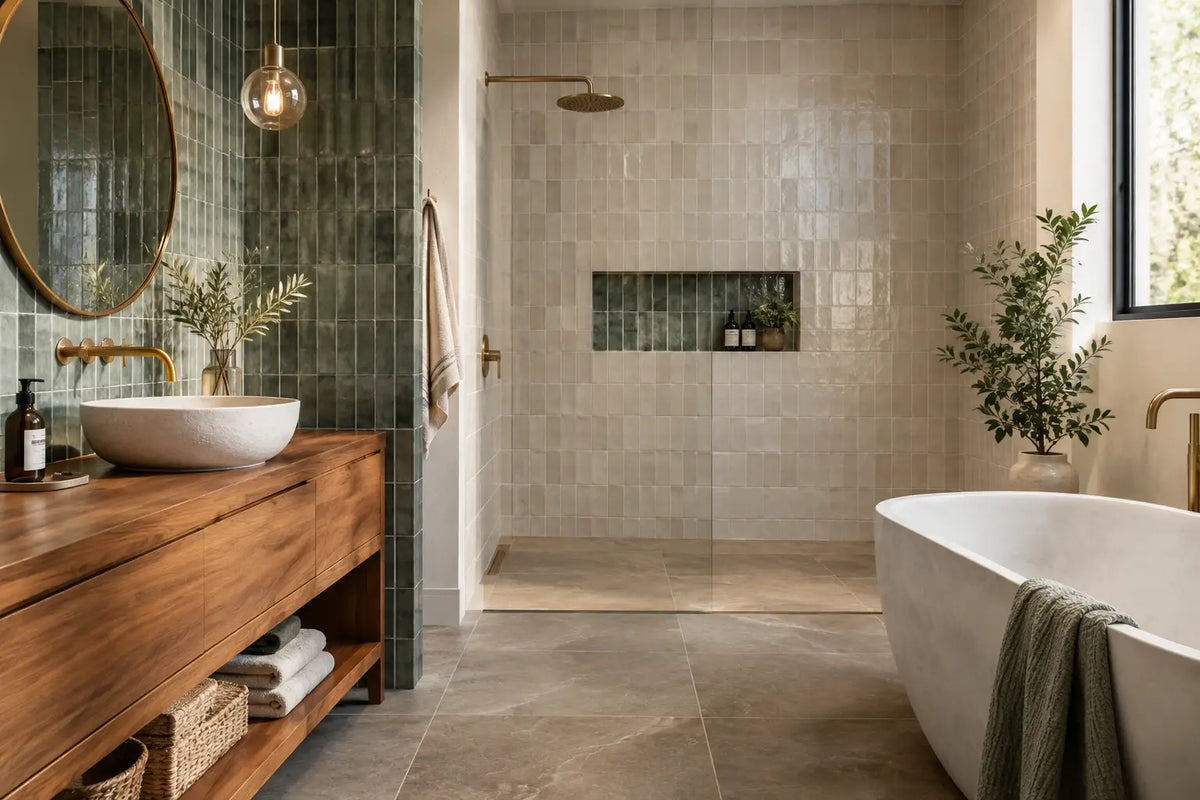
Article: Porcelain & Ceramic Tile Guide: The Right Tile, in the Right Place

Porcelain & Ceramic Tile Guide: The Right Tile, in the Right Place
A welcoming hotel entrance. A restaurant floor that earns its keep through every service. A bathroom ready for the morning rush. Behind each is the same good decision: tiles chosen for the job they will actually do.
At Smart Tiles, our porcelain and ceramic collections give you practical options for different surfaces and settings. The technical details help turn those options into confident choices. From low-absorption porcelain to purpose-made ceramic wall tiles and R11 grip finishes, the aim is simple: match the product’s stated performance to the way your space will be used.
This guide brings together the essentials from our buying, installation and commercial tile articles. No trends to chase. Just clear advice to help you choose well and enjoy a surface that works hard for years to come.
Find your footing: what’s in this guide
- 1. Porcelain and ceramic: two materials, plenty of strengths
- 2. Walls and floors: put the right performance to work
- 3. Strength and wear: built around your daily demands
- 4. Slip ratings: turning test results into useful choices
- 5. A practical match for every part of your project
- 6. Water resistance and waterproofing: a dependable partnership
- 7. Stain resistance and straightforward care
- 8. Installation: give good tiles the right foundation
- 9. Safer spaces, from fitting to everyday use
- 10. Lasting value and your next step
1. Porcelain and ceramic: two materials, plenty of strengths
Porcelain is part of the ceramic family. In everyday tile shopping, “ceramic” usually means non-porcelain ceramic. Both have valuable roles, and choosing between them is about the application rather than declaring one the winner.
Porcelain’s advantage is its dense, low-absorption body. With water absorption of 0.5% or less, it is a practical starting point for floors exposed to regular use and moisture. Our porcelain ranges offer options for kitchens, bathrooms and more demanding projects, with the exact product specification determining the right fit.
Glazed ceramic excels as an easy-care wall finish. Its protective face resists everyday splashes and staining, making suitable ceramic wall tiles a rewarding choice for bathroom walls, splashbacks and hospitality interiors. The body is generally more absorbent than porcelain, so wet-area preparation remains part of the installation.
That is the benefit of choosing by purpose: the right performance where you need it, without paying for floor-duty properties on a wall that will never see a trolley wheel.
2. Walls and floors: put the right performance to work
A clearly stated application is reassuring. It tells you where a tile’s properties can be put to good use. Our Nature 3.8 × 23.5cm ceramic collection, for example, is specifically designed for walls. It is an option to explore when your project calls for a ceramic wall finish, rather than a floor surface.
For a product that offers both applications, our Derwent 100 × 100 porcelain collection is listed for wall and floor use, with an R11 Softgrip finish and stated kitchen and bathroom suitability. Those details provide a useful starting point for matching it to your project.
Floors need the appropriate strength, wear resistance and grip; walls need a suitable background and fixing system for the installed weight. Some ceramic tiles are floor-rated, while decorative wall-only products should remain on walls. For large porcelain pieces, agreeing the wall construction and installation method with your installer helps make the most of the tile’s versatility.
3. Strength and wear: built around your daily demands
Durability becomes much more useful when it is tied to real life. Family foot traffic, restaurant chairs and hotel luggage all ask different things of a floor. Porcelain’s hard-wearing character makes it a strong material to consider, while the product data helps narrow the choice.
Surface wear: PEI abrasion classes describe resistance to visible wear on glazed floor tiles. Higher classes generally indicate greater wear resistance. Read them alongside the manufacturer’s stated applications to match the surface to the traffic. Unglazed tiles use different wear assessments; PEI is not a slip or breaking-strength rating.
Loads and impact: for retail displays, heavy furniture, equipment or wheeled traffic, include breaking strength and loading requirements in the brief. Tile thickness, format, adhesive support and the floor beneath all contribute. This is how a commercial shortlist becomes a specification suited to the actual working conditions.
Everyday appearance: through-body products can make minor chips less noticeable, although no tile is immune to impact. Colour-bodied tiles do not necessarily carry their surface pattern through the body. Simple measures such as entrance matting and grit removal help preserve the finish you have invested in.
4. Slip ratings: turning test results into useful choices
Slip ratings are useful selection tools. They help move the conversation from “this feels grippy” to “this finish has relevant performance information”. Our range includes R11 options such as Derwent Softgrip, giving customers a practical route to explore where greater shod ramp-test grip is part of the brief.
R9 to R13: what the levels tell you
The R classification comes from a ramp test using footwear and oil. Higher classes indicate performance at steeper test angles. Here is how the levels help shape a shortlist, rather than act as automatic room approvals.
- R9: the lower end of the scale, associated with dry internal applications. It is not evidence of wet suitability; HSE specifically cautions about R9 flooring in wet conditions.
- R10: increased ramp-test grip, often considered when shortlisting tiles for domestic circulation areas, kitchens and some general interiors. Where spills or wet shoes are expected, relevant wet-performance evidence is still important.
- R11: a higher ramp-test classification, often considered for more demanding entrances, bathrooms and commercial projects. Our Derwent range is an R11 example listed for kitchens and bathrooms. For shower floors, wet barefoot performance and drainage also need to match the design.
- R12: towards the higher end, commonly considered for more demanding working environments where contamination requires a specialist flooring specification.
- R13: the highest R class, associated with particularly demanding industrial or processing conditions. It is a specialist choice, not a requirement for every commercial floor.
How does that help you choose? Tell us whether you are fitting a family bathroom, a wet entrance or a hospitality space, and include the likely water, grease, footwear and cleaning conditions. The R rating helps identify candidate finishes; the product’s intended use and the other relevant test information establish whether they meet the project brief. A higher rating is valuable when it answers the right need, not simply because the number is bigger.
PTV: confidence grounded in the conditions tested
Pendulum testing offers further evidence for floor selection. HSE classifies results as 0–24: high slip potential; 25–35: moderate; 36 and above: low, in the conditions tested. For a potentially wet commercial entrance, the relevant wet result is more useful than a dry-only figure.
For commercial schemes, review the report’s slider, surface condition and test directions where relevant alongside slopes, users and likely contamination. A water-wet result does not describe grease contamination, and an R rating cannot be converted directly into a PTV. Bringing the right evidence together is what makes the recommendation meaningful.
Bathrooms and showers: include barefoot performance
Wet barefoot classes A, B and C come from a separate ramp assessment, with progressively more demanding classifications. These are relevant to showers, spas, changing facilities and pool environments. For a bathroom used in shoes, an R rating is useful information; for a wet shower floor used barefoot, include the relevant barefoot evidence too.
This is a positive distinction: it lets you select a tile for the way people actually use the space. Our slip-resistance guide and HSE’s flooring test guidance explain the assessments in more detail.
5. A practical match for every part of your project
Homes: dependable surfaces for busy routines
Kitchens and halls benefit from a floor chosen for regular traffic, spills and tracked-in dirt. Bathrooms add wet feet and cleaning products. Derwent’s listed kitchen and bathroom suitability, porcelain construction and R11 Softgrip finish make it a useful collection to discuss for these settings. Where the floor forms part of a shower, confirm the wet barefoot specification and whether the format suits the drain and falls.
Retail: welcome customers with performance in mind
For a shop, start with commercial-use suitability, expected wear, display loads and the entrance conditions. Higher-R grip finishes can be useful candidates where added traction is part of the brief, supported by relevant wet-test data when rain is likely. Effective matting and tidy thresholds complete the entrance strategy. The aim is a floor selected to support daily trading, not just opening-day footfall.
Restaurants: choose by working zone
A dining room, bar and professional kitchen have different needs. Porcelain offers a practical material starting point for many hospitality floors; the selected product must match each zone’s traffic, contamination and cleaning demands. Higher-R products may form part of a commercial shortlist, but kitchen use also requires evidence relevant to grease, water and the operating conditions. Appropriate drainage and grout bring the specification together.
Hotels: a coordinated approach, room by room
Reception floors welcome wet arrivals and luggage; corridors take housekeeping traffic; guest bathrooms need dependable moisture management and easy care. Spas and communal showers introduce wet barefoot use. Selecting the appropriate finish for each zone lets a hotel benefit from porcelain’s versatility without expecting one surface specification to cover every task.
Outdoors and specialist locations
Our Pietra Ligure Anthracite Outdoor 80 × 80 is listed for outdoor use, illustrating the value of selecting a product made for the intended setting. Match exterior choices to confirmed frost suitability, wet-slip performance, drainage and the proposed laying method. For commercial terraces, include the project’s loading and slip requirements too.
Porcelain and ceramic can also work well over underfloor heating as part of a compatible system. Around fireplaces, agree the tile, background, adhesive and appliance clearances for the expected temperatures. Careful product matching opens up useful applications while keeping the whole construction appropriate to the job.
6. Water resistance and waterproofing: a dependable partnership
Porcelain’s low absorption is a genuine practical advantage in bathrooms and other moisture-prone settings. Glazed ceramic offers an easy-clean, water-resistant face for suitable wall applications. Pair either with the correct wet-area construction and you have the basis of a dependable tiled finish.
In showers and wet rooms, the waterproofing system protects the background, while the tiles provide the durable wearing surface. Sealed junctions, pipe penetrations and drain connections work together with properly formed falls to manage water effectively.
Grout and sealers support the finish but do not replace tanking. Likewise, an uncoupling membrane provides waterproofing only where its system and sealed detailing specify it. Our shower waterproofing guide explains how these elements fit together. Choosing the full system is an investment in the life of the room, not an unnecessary extra.
7. Stain resistance and straightforward care
Resistance to everyday staining is one of the reasons porcelain and glazed ceramic are such appealing working surfaces. Suitable products offer practical options for kitchen splashes, bathroom toiletries and the regular cleaning that hospitality spaces require.
Match the finish and grout to the routine. Most porcelain and glazed ceramic do not routinely need sealing, while polished, unglazed, crackle-glazed and specialist finishes may have their own instructions. Following those instructions protects the performance and avoids unnecessary treatments.
For more demanding food-service or washroom environments, a suitable epoxy grout can offer useful stain and chemical resistance. Check compatibility with the actual cleaning chemicals and concentrations. Grout selection is another opportunity to tailor the installation to its working life.
Routine care is straightforward: remove grit, deal with spills promptly and use a compatible cleaner at the recommended dilution. Textured surfaces may benefit from brushing or mechanical cleaning and effective dirty-water removal. For larger commercial projects, a cleaning trial helps select a finish that suits both the safety brief and the facilities team.
8. Installation: give good tiles the right foundation
Quality tile selection and good installation are a partnership. A sound, sufficiently rigid and properly prepared background gives the tile the support it needs to deliver its intended performance.
Agree primers, levelling materials, adhesive, grout and any membranes as a compatible system for the substrate and use. Large-format porcelain rewards careful preparation and bedding, especially where commercial loads are expected. An uncoupling layer can help manage certain stresses, but structural rigidity still comes from the construction beneath it.
Plan structural, perimeter and intermediate movement joints, and retain the recommended grout joints even with rectified tiles. These details allow for the movement a real building experiences, helping protect the finished surface over time.
In wet areas, coordinate the tile format with drainage. Over heating, follow curing and gradual commissioning instructions. For commercial projects, build drying times and protection from following trades into the programme. Getting these details agreed early keeps the benefits of your chosen tiles working together.
9. Safer spaces, from fitting to everyday use
A well-matched tile makes a valuable contribution to a safer floor. For commercial projects, bring its stated applications and test evidence into the site-specific risk assessment, alongside users, footwear, contamination, gradients and maintenance. This gives the selection a clear, practical basis.
During installation, plan safe handling and cutting methods. Cutting or grinding tiles can release harmful respirable crystalline silica dust, so use suitable task-specific controls such as appropriate water suppression or extraction, with respiratory protection where the assessment requires it. Tight-fitting respiratory protection needs appropriate face-fit testing. Follow equipment and installation-product safety instructions.
Once the space is in use, prompt spill removal, leak repairs and a suitable cleaning routine help preserve the floor’s performance. Manage access during wet cleaning and inspect joints, transitions and damaged areas. Good housekeeping helps the chosen surface do its job.
For supporting advice, see HSE’s catering slips guidance and dust-control guidance covering ceramic and porcelain. Product information supports the selection; the project team assesses the completed installation and its operation.
10. Lasting value and your next step
Correctly selected, installed and maintained porcelain and ceramic tiles can serve for decades. Their value lies in a durable surface that suits its setting, stays manageable to clean and can continue working through years of everyday use. Actual service life depends on traffic, impact, installation and care; grout and sealants may need maintenance before the tile itself.
Before ordering, bring together the product name, finish, size, stated application, relevant slip and wear evidence, loading needs and installation system. Measure for the actual layout and keep matching spares from the original batch. For hotels, shops and restaurants, that reserve can make a future repair far simpler.
Planning a project? Tell Smart Tiles where the tiles are going, how the space will be used and what the installation needs to achieve. We can help you explore the options, using the available product information to guide the discussion and identifying any project-specific details that need confirmation with the manufacturer or your specifier.
The best choice is not simply the highest number on a datasheet. It is the right combination of material, surface and installation for your space. That is how technical information becomes something far more useful: confidence in the tiles beneath your feet and on your walls.