Article: Tile Slip Resistance Guide for Safer Floors
Tile Slip Resistance Guide for Safer Floors
A beautiful floor can change the character of a hallway, bathroom or hospitality space, but its finish also has a practical job to do. This tile slip resistance guide helps you assess that performance before ordering, so the tile you choose suits the way the area will actually be used - from dry family kitchens to busy commercial entrances.
Slip resistance is not a single universal property. A tile’s performance changes with water, footwear, contaminants, cleaning methods, gradients and even how well the floor is maintained. The right specification is therefore a balance: enough grip for the risk level, while retaining the appearance, cleanability and underfoot comfort the project requires.
Tile slip resistance guide: start with the location
Begin with the room, its users and what may reach the floor. A polished porcelain tile can be an excellent choice for a dry, low-risk cloakroom or feature area, but it may be unsuitable for a shower room, poolside changing area or entrance exposed to rain and grit.
For residential projects, bathrooms, utility rooms, kitchens and entrance halls deserve closer consideration. Think about wet feet after bathing, drips from washing, muddy shoes, pets, children and the frequency of cleaning. A level-access shower requires a more cautious specification than the main bathroom floor because water is present more often and users may be barefoot.
For commercial interiors, assess expected footfall and the nature of the operation. A boutique hotel lobby, restaurant entrance, café servery or retail threshold may need a tile that performs when wet, while maintaining an appropriate design standard. Back-of-house spaces, commercial kitchens and changing facilities often face more demanding contaminants and cleaning regimes than public areas.
There is no benefit in choosing the highest-grip tile in every room. Very textured surfaces can hold dirt, feel harsher underfoot and require more careful cleaning. The aim is a considered finish, not simply the roughest available option.
Understanding R ratings for floor tiles
Many porcelain floor tiles are given an R rating, commonly R9 to R13. This rating comes from a ramp test carried out with a person wearing standard work shoes while the surface is coated with oil. As the ramp angle increases, the tile’s resistance to slipping is assessed.
In broad terms, R9 is typically used for dry internal settings with a lower slip-risk profile. R10 provides greater resistance and is frequently considered for domestic kitchens, hallways, bathrooms and general commercial interiors where occasional moisture may occur. R11 is often selected where wet conditions are more likely, while R12 and R13 are generally associated with more specialist, industrial or heavily contaminated settings.
These descriptions are useful starting points, not automatic rules. An R10 tile may be an attractive and suitable choice for a kitchen, but whether it is right depends on the tile format, layout, grout joints, anticipated spillages and the people using the space. Conversely, an R12 surface may be unnecessary and difficult to maintain in a refined residential interior.
R ratings are particularly relevant where footwear is normally worn. They should not be treated as a complete measure of barefoot safety, and they do not tell you how a tile will perform in every real-life condition.
Why surface finish matters
Slip resistance is closely tied to the tile’s texture. Polished and high-gloss finishes usually offer less grip when wet than matt, structured or grip finishes. A matt tile is not automatically slip resistant, however. Always check the technical information for the individual product rather than relying on its visual description.
Stone-effect and concrete-effect porcelains are often available in different surface options. A smoother indoor finish can be used across living areas, while a corresponding grip finish may suit a threshold, covered terrace or wet zone. Matching the colour and design across these areas creates a more continuous scheme without asking one finish to do every job.
PTV and pendulum testing explained
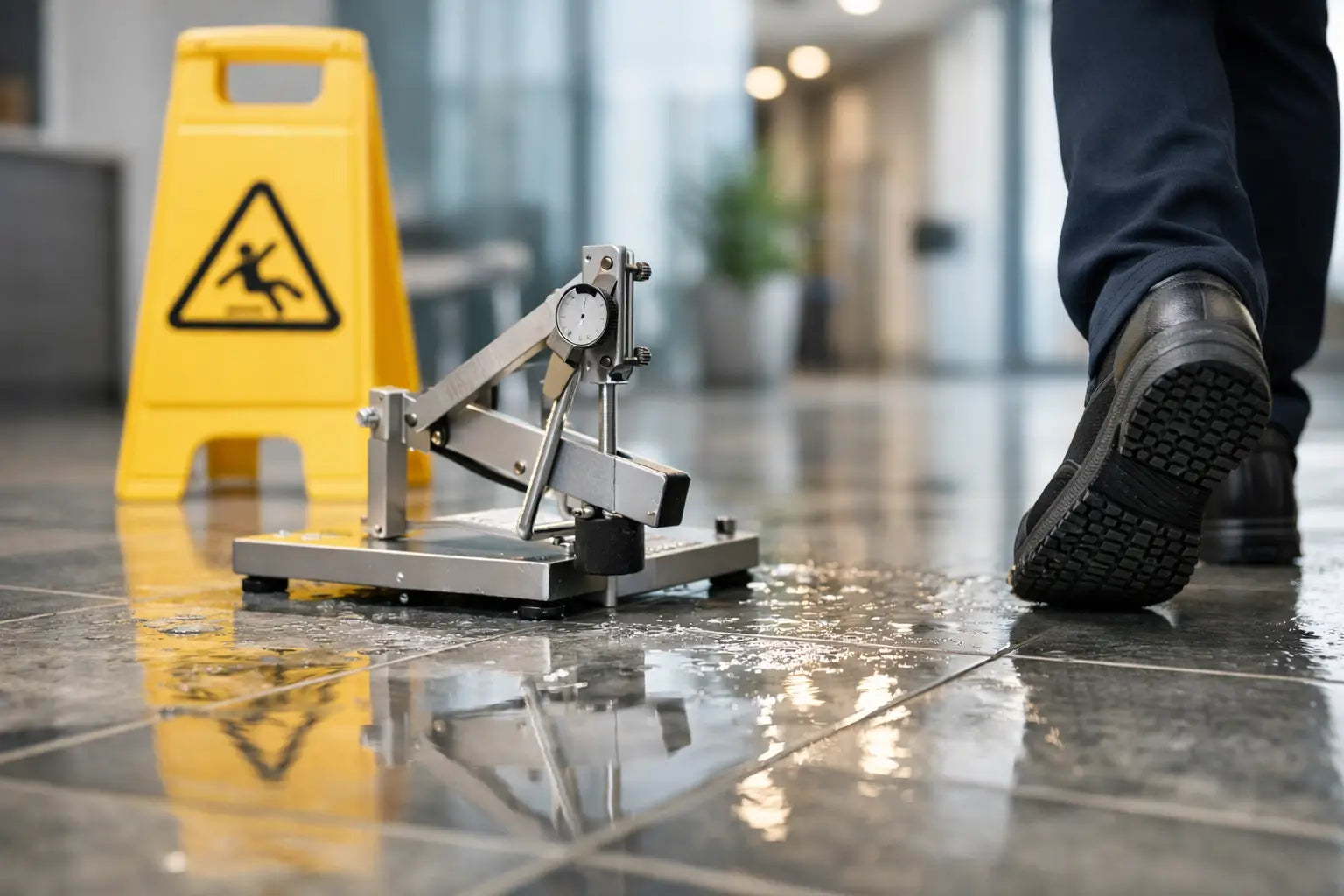
You may also see a Pendulum Test Value, or PTV, in a tile specification. This test uses a swinging rubber slider to measure friction at the surface. It can be carried out in dry and wet conditions, which makes the wet result especially useful when reviewing tiles for entrances, bathrooms and other areas exposed to water.
A PTV of 36 or above is widely regarded as indicating a lower potential for slip in the conditions tested. That is a helpful benchmark, but it must be read alongside the test method, slider type and whether the result applies to a clean, wet or contaminated surface. A technical datasheet should provide the relevant context.
For commercial or public-facing projects, the designer, contractor or responsible specifier should consider the whole floor system rather than relying on one figure. Drainage, matting, lighting, floor falls, cleaning products and the transition between surfaces can all influence safety. Where a site has a particular risk profile, obtain project-specific technical guidance before finalising the specification.
Barefoot areas need a different measure
Wet barefoot zones are commonly assessed using classes A, B and C under a separate ramp test. This is designed for locations such as shower areas, changing rooms and swimming-pool surrounds, where the type and depth of water exposure differ from a floor used with shoes.
Class A is generally for areas with lower exposure to water. Class B provides a higher level of barefoot grip and is often relevant to shower surrounds and changing facilities. Class C is intended for the most demanding wet barefoot conditions, including areas where gradients or water accumulation increase the risk.
A domestic wet room does not automatically need the same class as a public pool. Still, a shower tray area or level-access wet-room floor should be treated as a distinct zone. Smaller-format tiles can be advantageous here because additional grout joints improve grip and allow the floor to follow falls towards the drain accurately.
Consider tile size, grout and layout
A tile’s test result matters, but installation choices can strengthen or undermine the finished floor. Large-format porcelain creates a clean, contemporary look with fewer grout joints. It works particularly well in spacious bathrooms, kitchens and open-plan interiors. In wet areas, though, very large tiles can make achieving precise falls more difficult, especially around a linear or point drain.
Mosaics and smaller formats provide more joints underfoot, which can improve traction in shower areas. They are also more adaptable around curves and gradients. The trade-off is that they require more grout, more installation time and a more detailed cleaning routine.
Grout should be selected for the setting, not treated as an afterthought. A suitable grout colour can support the design, while the correct formulation helps the installation withstand moisture and regular cleaning. Movement joints, substrate preparation and a compatible adhesive system are equally important. A high-performing tile cannot compensate for poor falls, loose tiles or an uneven subfloor.
Do not overlook entrances and transitions
Many slips happen where people move from outdoors to indoors. Rainwater, fine grit and smooth-soled footwear can create a risk even when the internal tile is appropriate for normal dry use. A properly planned entrance should include sufficient matting to remove moisture and debris before visitors reach the tiled area.
Consider changes in finish too. A transition from an external grip porcelain to an internal matt tile should be level, clearly detailed and free from abrupt lips. In commercial projects, make sure drainage and threshold detailing are resolved early, rather than relying on matting to solve an unsuitable surface choice.
Cleaning affects slip resistance
A textured tile only performs as intended when its surface is clean. Grease, soap residue, polish, limescale and detergent build-up can all reduce traction. This is particularly relevant in kitchens, showers and hospitality settings.
Use cleaning products suited to porcelain and the level of contamination present. Avoid leaving cleaning solution on the floor, and rinse where the product instructions require it. For structured grip surfaces, a soft brush or mechanical cleaning method may be needed to lift dirt from the texture. A cleaning trial on a sample is worthwhile for larger commercial specifications or where a pale, textured finish is being considered.
Specify with the full project in mind
Before placing an order, request samples and view them in the actual lighting conditions where possible. Test how the surface feels with the footwear used in the space and, where appropriate, with wet bare feet. Samples are invaluable for judging colour and texture, although they do not replace certified technical data.
Confirm the tile’s intended application, rating and finish with the product information. Then allow for the full installation package: suitable preparation boards or levelling materials, adhesive, grout, trims, waterproofing and movement joints. For larger projects, keep the technical documentation with the project records so the chosen performance level is clear to everyone involved.
The best tile floor feels effortless once it is installed: visually right for the scheme, practical to maintain and reassuring underfoot. Choosing a finish that reflects the real conditions of the space is one of the simplest ways to protect both the design and the people who use it.