Wood Flooring Trends 2026 for UK Interiors
The strongest wood flooring trends 2026 are less about dramatic novelty and more about making a space feel settled, tactile and considered. Homeowners are moving away from heavily polished, uniform floors in favour of timber surfaces with believable grain, softer colour variation and finishes that work with daily life. For commercial schemes, the same direction supports warmer, more residential interiors without compromising on specification requirements.
The right trend should still earn its place in the project. Board construction, wear layer, subfloor condition and compatibility with underfloor heating matter just as much as the chosen shade. A well-selected floor can remain relevant for decades, while an unsuitable product can create avoidable fitting and maintenance issues from day one.
Wood Flooring Trends 2026: Natural, Warm and Textured
Pale Scandinavian-style floors are no longer the only route to a light interior. In 2026, the preference is shifting towards warmer neutrals: honeyed oak, biscuit, soft caramel, muted beige and mid-brown timber tones with gentle grey undertones. These colours bring more depth than a washed-out finish while remaining flexible enough for contemporary kitchens, traditional hallways and layered living spaces.
Natural oak remains the benchmark because it works across architectural styles. Its grain reads as authentic, it pairs easily with stone, porcelain and painted joinery, and it ages gracefully. The most sought-after versions are likely to show tonal variation rather than a completely uniform stain. This gives the finished floor a more convincing, character-led appearance.
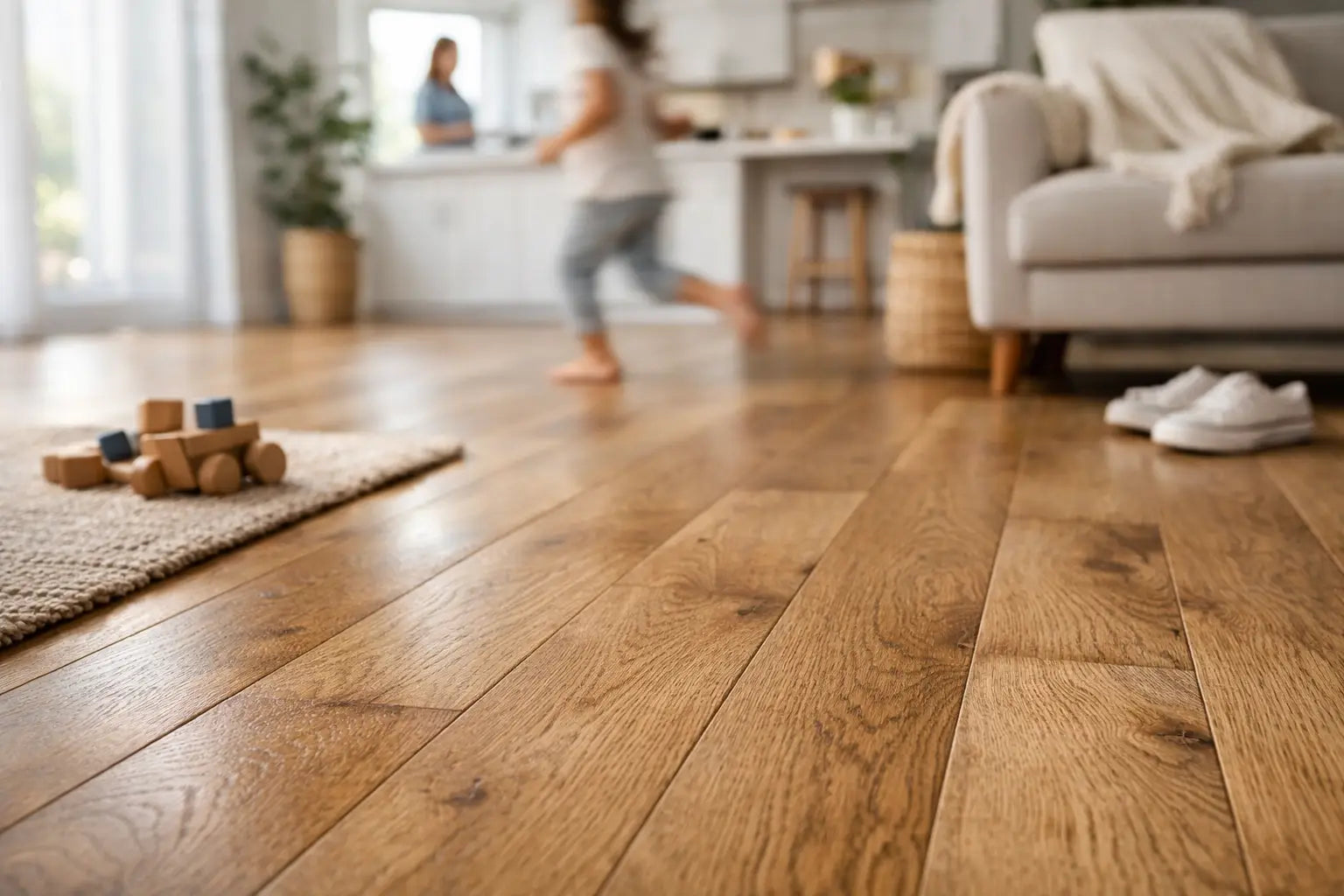
Texture is equally influential. Brushed and lightly textured surfaces continue to appeal because they reduce the overly formal look of smooth lacquered timber. A brushed finish follows the natural grain, creating a subtle tactile quality and helping everyday marks feel less obvious than they might on a high-gloss floor. This is particularly practical in busy family kitchens, entrance halls and hospitality settings.
There is a balance to strike. Deeply distressed boards can look overly stylised in smaller rooms or modern new-builds, while very flat, pale finishes may show every scuff. A lightly brushed oak with a low-sheen matt finish is often the safest specification where longevity and broad design appeal are priorities.
Wider Boards Create a Calmer Floor
Wide-plank flooring remains a key direction for larger homes and open-plan projects. Fewer joins across the room create a calmer visual field, allowing the grain and natural movement of the timber to take centre stage. Wider boards can make a generous room feel more considered and can also give a modest space a less busy appearance when laid in the right direction.
Longer board lengths add further refinement. They are especially effective in living rooms, dining spaces and hotel-style bedroom schemes, where a continuous run of boards helps the room feel more expansive. Random-length packs can still offer a natural layout, but the installer should plan the distribution carefully to avoid repeated short-end joints.
Wide boards are not automatically the best answer for every space. Narrow hallways, period properties with irregular walls and small cloakrooms may benefit from a more traditional board width. The dimensions of the room, the amount of natural light and the direction of travel all influence how a floor will read once installed.
Herringbone Becomes More Relaxed
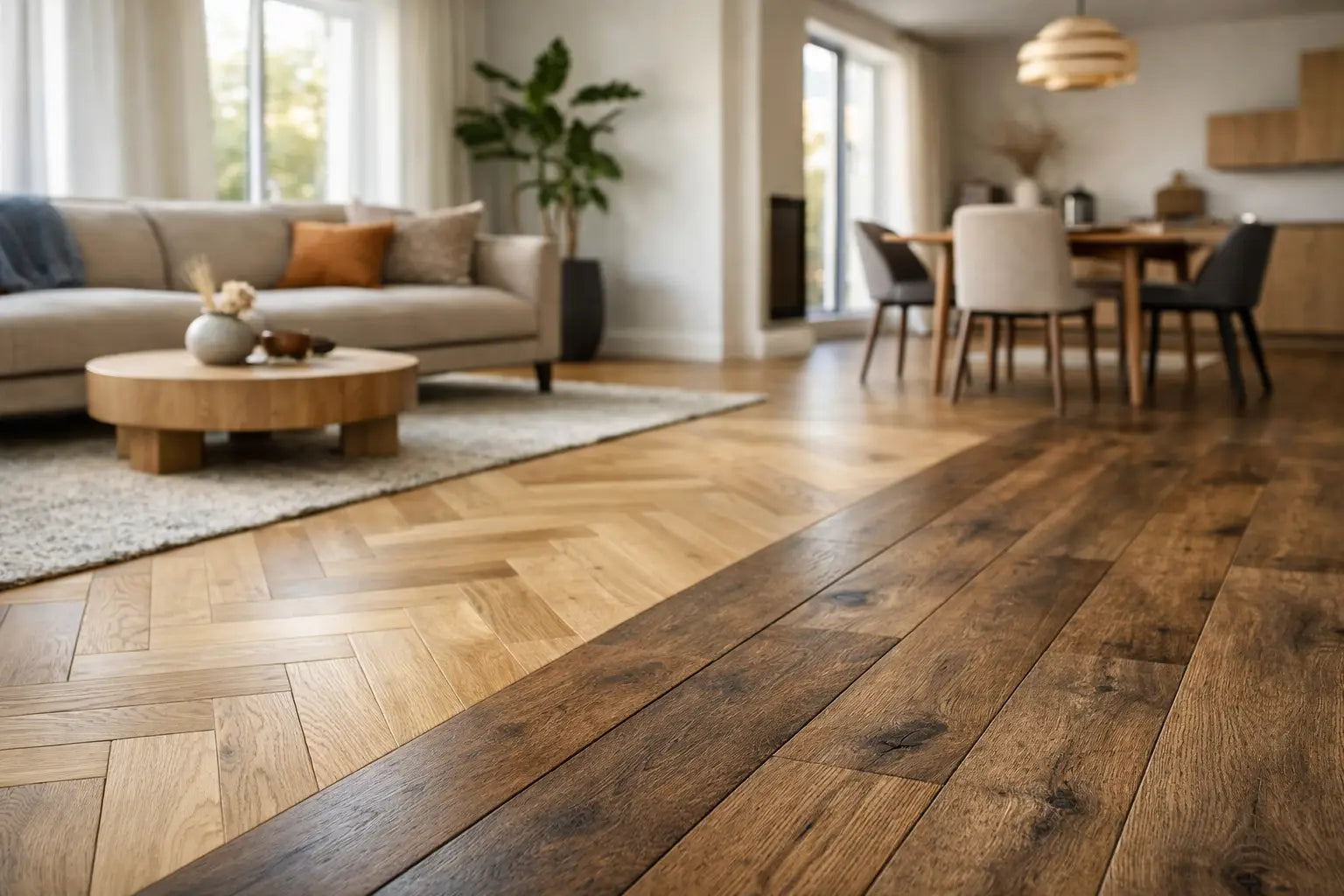
Herringbone is firmly established rather than a passing fashion, but its use in 2026 is becoming more selective. Instead of treating it as a feature for every room, designers are using it where the pattern adds genuine architectural value: entrance halls, formal reception rooms, dining areas and boutique commercial spaces.
The current preference is for quieter colour palettes and smaller-format blocks that let the pattern speak without making the floor feel overly busy. Natural oak, warm medium brown and gently smoked tones work particularly well. Matching a herringbone floor with simple wall finishes, plain cabinetry or large-format porcelain can prevent the overall scheme from becoming too decorative.
Straight plank remains the more economical and efficient choice for many projects. It generally creates less installation complexity and can involve lower labour costs. Herringbone needs a sound, level substrate and precise setting out, so it should be specified with appropriate allowances for preparation, cuts and fitting time.
Borders and Feature Detailing
For higher-end residential and commercial interiors, a border or contrasting perimeter detail can give herringbone and plank flooring a tailored finish. This works best in rooms with clear proportions and carefully planned thresholds. It is a detail to discuss early, as it affects quantities, layout and the transition to adjoining surfaces.
Matt Finishes Take Priority Over High Gloss
Low-sheen finishes are central to the 2026 look. A matt oiled or matt lacquered floor feels more natural under changing daylight and does not create the reflective, almost plastic appearance associated with high-gloss timber. It also sits comfortably alongside tactile materials such as linen, limewash, natural stone and textured porcelain.
An oiled finish is valued for its depth and repairability. Depending on the product and damage, localised areas may be refreshed without refinishing the whole floor. However, it requires a proper maintenance routine and the correct cleaning products. It suits customers prepared to care for a natural surface and maintain its appearance over time.
Matt lacquered wood flooring is often the more straightforward option for households that want practical protection with lower routine maintenance. Modern lacquers can offer an understated appearance while helping resist everyday spills and marks. The best choice depends on how the room is used, not simply on which finish is currently fashionable.
Engineered Wood Leads for Practical Specification
Engineered wood flooring continues to be the most practical timber choice for many UK renovation projects. Its layered construction provides improved dimensional stability compared with solid wood, making it better suited to changing indoor conditions and, where the manufacturer confirms suitability, water-based underfloor heating.
A quality engineered board has a real timber wear layer over a stable core. The thickness of that wear layer matters, particularly where future sanding and refinishing are expected. It is worth comparing the full specification rather than choosing on board appearance alone: overall thickness, wear layer, joint system, finish and fitting method all influence performance.
Solid wood still has a place, particularly in carefully controlled environments and heritage-led projects, but it is less forgiving of moisture and temperature fluctuation. Kitchens, ground floors and rooms with underfloor heating require especially careful consideration. Engineered wood provides the natural character of real timber with a construction better aligned to the demands of modern homes.
Smoked and Mid-Tone Woods Add Depth
Very dark espresso floors have become less dominant, but deeper timber is far from disappearing. The newer preference is for smoked oak, roasted brown and medium walnut-inspired tones that retain visible grain. These finishes offer contrast and richness without making the room feel heavy.
Mid-tone timber can be an excellent choice in rooms with strong daylight, pale walls or contemporary glazing. It grounds an otherwise minimal interior and complements brass, bronze, deep green, terracotta and off-white joinery. In north-facing rooms, however, an overly dark floor can absorb valuable light, so samples should always be viewed in the actual space at different times of day.
Colour matching also deserves attention. Timber is a natural material, meaning variation between boards is part of its appeal. Samples are useful for judging the overall tone, but they cannot show every knot, grain pattern or shade variation that will appear across a full installation.
Specification Details That Should Not Be Treated as a Trend
A floor only performs as well as the preparation beneath it. Before ordering, confirm the room measurements, add an appropriate wastage allowance for the layout, and establish whether the subfloor is level, dry and structurally sound. Moisture testing is particularly important on concrete or newly screeded subfloors.
The installation method should suit both the product and the site. Floating installations can be efficient for certain click systems, while fully bonding a wood floor can provide a more solid feel underfoot and may be required for particular board types or underfloor heating systems. Use compatible primers, levelling compounds, adhesives and moisture barriers as specified by the manufacturer.
Door clearances, thresholds, skirting details and expansion space also need to be planned before fitting begins. These are small decisions on paper but highly visible once the project is complete. Smart Tiles can help customers coordinate wood flooring with suitable preparation and installation materials, keeping the specification focused from sample stage through to fitting.
Choosing a Floor That Will Still Look Right in Years to Come
The most enduring 2026 direction is not a single colour or laying pattern. It is a floor with natural character, an appropriate finish and a construction that suits the building. Choose samples alongside cabinetry, paint, tiles and fabric finishes, then assess them in the room rather than under showroom lighting alone.
A warm, well-made timber floor should support the life of the space, whether that means muddy shoes in a family hallway, daily service in a restaurant or quiet comfort in a principal bedroom. Start with performance, choose a tone you will enjoy living with, and let the grain do the rest.