Vinyl Versus Wood Flooring for Your Project
A floor has to do more than look right under showroom lighting. It must suit the way a room is used, work with the existing subfloor, and hold its finish through muddy shoes, pets, dining chairs and daily footfall. When comparing vinyl versus wood flooring, the best choice is rarely about one material being universally better. It is about selecting the right surface for the room, the design scheme and the practical demands of the project.
Wood brings natural character, tactile warmth and a finish that can add real depth to a renovation. Vinyl offers impressive design flexibility, dependable water resistance and a lower-maintenance option for busy spaces. Both can look premium when carefully chosen and professionally installed, but they perform differently over time.
Vinyl versus wood flooring: the key differences
The most obvious difference is construction. Wood flooring is made from real timber. Solid wood is formed from a single piece of hardwood, while engineered wood has a real timber wear layer bonded to a stable multi-layer core. This construction gives engineered boards the visual appeal of natural oak, walnut or other timbers, with improved dimensional stability for many modern interiors.
Vinyl flooring is a manufactured product, available in sheet vinyl, luxury vinyl tile (LVT) and luxury vinyl plank (LVP) formats. Design layers can reproduce timber grain, knots, colour variation and plank formats with considerable realism. Quality vinyl flooring also has a protective wear layer that helps it resist scuffs, stains and everyday moisture.
For a project where authentic, changing natural grain is central to the brief, real wood has a quality that cannot be completely replicated. Every board has its own variation, and the floor can develop character as it ages. For spaces where consistency, easy cleaning and water resistance take priority, vinyl is often the more straightforward specification.
Appearance and design direction
Wood flooring suits interiors where material authenticity is part of the design. A wide-plank brushed oak can create a calm, architectural base in an open-plan kitchen or living area, while a herringbone layout adds formality and detail to a period property, boutique hotel or reception space. Finishes such as oiled, lacquered, smoked and matt allow the floor to be tailored to the wider palette.
It is worth remembering that wood is not a uniform product. Samples are essential because tone, grain and natural features vary between boards and batches. This is a strength when a layered, individual finish is wanted, but it needs to be considered alongside cabinetry, wall finishes and natural light.
Vinyl has a different design advantage. It can deliver a clean, controlled timber look in colours ranging from pale Scandinavian-style oak to richer smoked and aged effects. It also makes it possible to continue a practical wood-look floor through rooms where real timber would be less suitable. A consistent plank design can run from a hallway into a kitchen, utility or cloakroom without creating a visual break at the doorway.
For high-end schemes, look beyond the basic colour. Consider plank size, embossed texture, bevelled edges and the level of surface sheen. A convincing vinyl floor should have enough texture and tonal movement to avoid a flat, repetitive appearance. Equally, the chosen wood should complement the scale of the room rather than overpower it with too much grain or an overly rustic grade.
Water, wear and everyday living
Moisture is often the deciding factor. Vinyl is a strong option for kitchens, utility rooms, entrance areas and ground-floor spaces that receive regular wet footwear or spillages. Many vinyl products are water resistant or waterproof, depending on their construction and installation system, and are easy to wipe clean. That does not remove the need for sound preparation or correct sealing at edges and junctions, but it provides useful reassurance in hardworking areas.
Real wood is better kept away from rooms with sustained moisture, standing water or frequent humidity changes. Spills should be cleaned promptly, and mats are sensible at external doors. Engineered wood is generally more stable than solid wood, but it is still a natural material and should not be treated as waterproof.
In living rooms, bedrooms and dining spaces, both materials can perform very well. Wood may show dents, scratches and marks over time, particularly in softwood or heavily brushed finishes. Some homeowners see this as a desirable patina, while others prefer a floor that remains visually consistent with minimal intervention. Vinyl is more resistant to everyday scuffs, although it can still be damaged by sharp objects, dragged furniture and heavy point loads. Felt pads, entrance mats and suitable furniture protection remain worthwhile whichever floor is selected.
Commercial and hospitality projects need a more detailed assessment. Expected footfall, cleaning regimes, rolling loads and required slip resistance should all influence the specification. A domestic-grade vinyl product may not be suitable for a busy café, hotel corridor or retail setting, just as a beautiful timber floor may need a more considered maintenance plan in a public-facing space.
Comfort, acoustics and underfloor heating
Wood has an immediate warmth underfoot that appeals in bedrooms and living areas. It can also help a room feel less echoing than hard ceramic or porcelain surfaces. Vinyl is naturally softer and quieter than many hard floor coverings too, particularly when paired with an appropriate underlay where the product and installation method allow it.
For flats, upper floors and multi-occupancy settings, acoustic performance should be checked at the outset. The floor finish is only part of the solution. Subfloor construction, acoustic underlay, levelling compounds and installation method all affect impact sound transmission. This is a technical area where choosing compatible materials matters more than selecting a product on appearance alone.
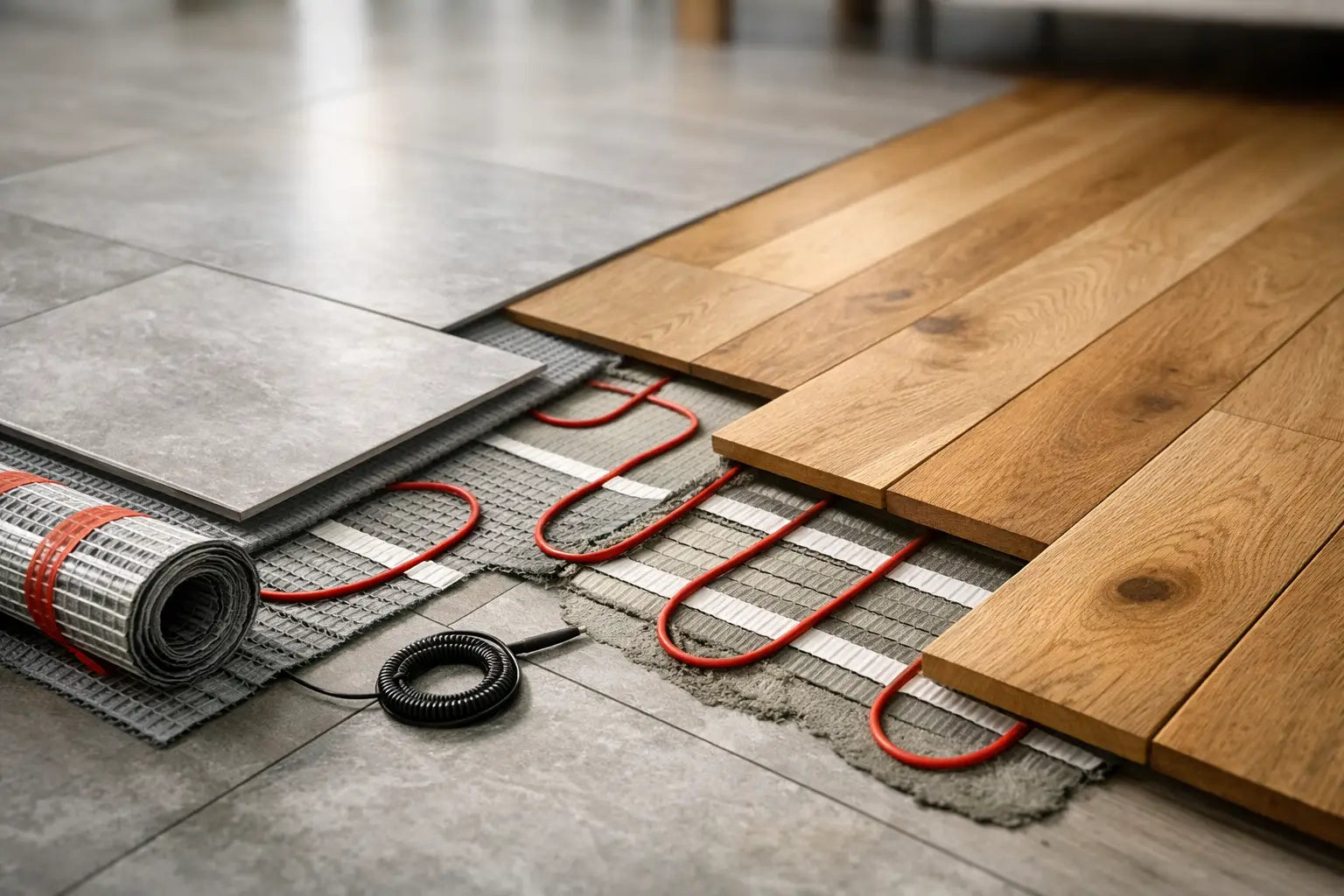
Both engineered wood and many vinyl systems can work with underfloor heating, provided the product is approved for it and the heating system is operated within the manufacturer’s temperature limits. Engineered wood is normally the more suitable wood option because its layered construction manages movement better than solid timber. Vinyl responds efficiently to heat due to its relatively thin build-up, but the subfloor must be smooth and stable, as imperfections can telegraph through the surface.
Installation is where performance is decided
A premium floor can disappoint if it is installed over an unsuitable base. Wood and vinyl have different tolerances, moisture requirements and fitting methods, so a subfloor survey should come before final product selection.
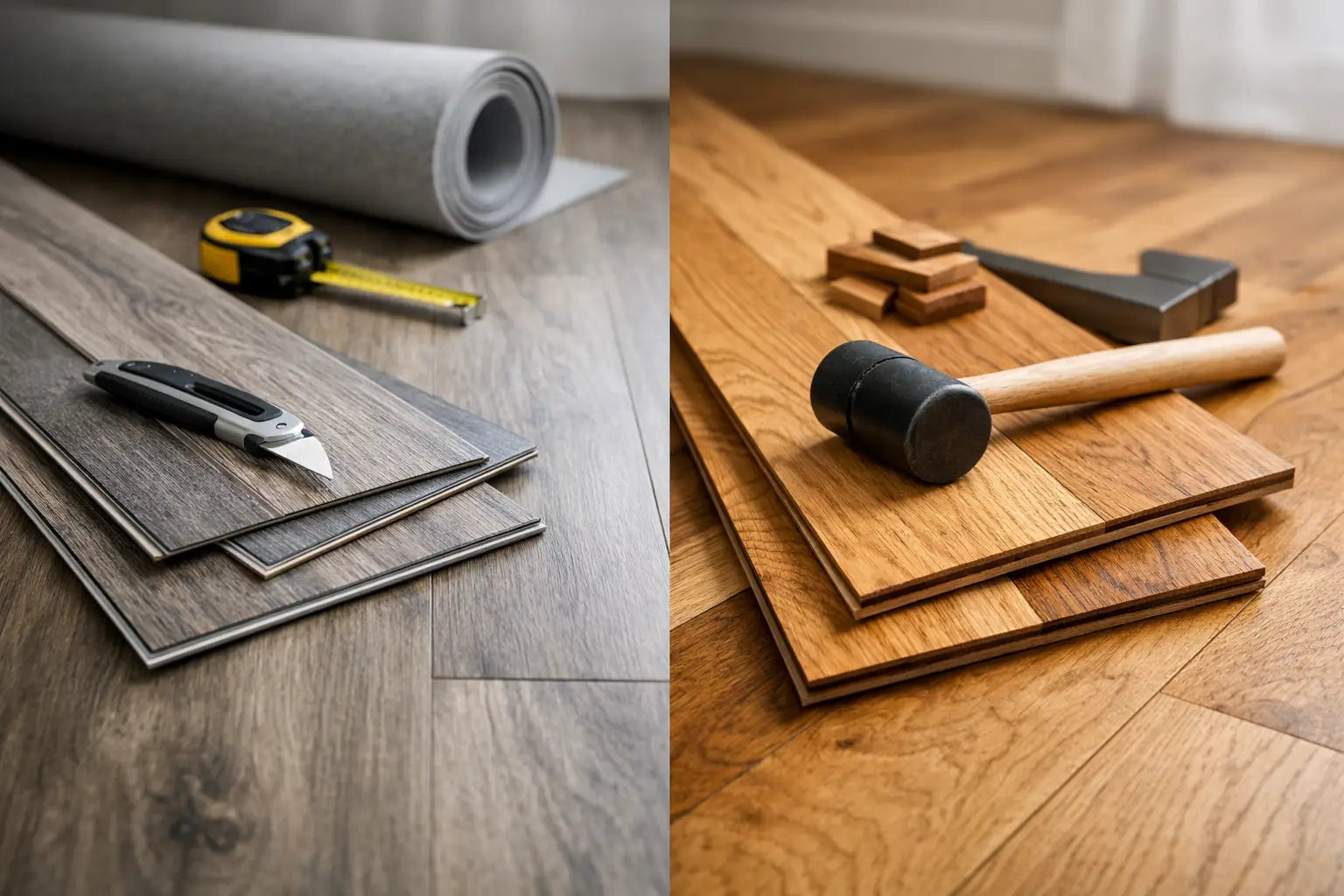
Wood flooring may be floated, glued down or mechanically fixed, depending on the board and subfloor. It usually requires acclimatisation before fitting and carefully managed expansion gaps around the perimeter. The moisture content of the subfloor must be tested, particularly with new screeds or ground-floor concrete. Skipping this stage risks cupping, gaps, movement or bond failure.
Vinyl is less forgiving of surface imperfections than many people expect. Glue-down LVT requires a very smooth, properly prepared base. Click vinyl can be quicker to install and may accommodate minor variation better, but it still needs a flat, sound subfloor to avoid movement at joints. In renovation work, the cost of preparing the floor properly should be included from the beginning rather than treated as an unexpected extra.
This is also the point to plan trims, thresholds, skirting details, door clearances and transitions to other finishes. A flooring choice should feel resolved at edges and doorways, not simply fitted into the available space.
Cost, maintenance and long-term value
Initial price is only one part of the calculation. Vinyl can offer a lower installed cost than quality engineered wood, especially where a practical, durable finish is needed across several rooms. It also has predictable maintenance: regular vacuuming or sweeping, prompt cleaning of spills and manufacturer-approved cleaning products are usually sufficient.
Wood often represents a greater initial investment, particularly in wider planks, specialist finishes or patterned formats. In return, it offers longevity and the potential for renovation. Some engineered wood floors with a sufficiently thick wear layer can be lightly sanded and refinished, while solid wood may be restored several times. Whether this is worthwhile depends on the floor’s condition, construction and the desired finish.
Neither choice should be judged by material price alone. Include waste allowance, subfloor preparation, adhesives or underlays, trims, delivery access and fitting. For larger projects, ordering sufficient material from the same batch and allowing for future repairs can avoid unnecessary delays later.
Choosing the right floor for each room
Choose wood where natural material, visual depth and a warm, enduring finish are the priorities. It is particularly effective in lounges, dining rooms, bedrooms and carefully managed open-plan spaces. Engineered wood is usually the practical starting point for homes with underfloor heating or where greater stability is required.
Choose vinyl where water resistance, easier maintenance and design continuity matter most. It is well suited to kitchens, hallways, utility rooms, cloakrooms and family spaces that experience regular traffic. It can also be the sensible choice where a timber appearance is wanted but the project needs a thinner floor build-up or a more controlled budget.
The strongest specifications do not force one material into every room. A considered combination can deliver the right balance: authentic wood in the spaces where it will be appreciated most, and quality vinyl in areas that need to work harder. Before placing an order, view samples in the room, assess the subfloor and confirm the full installation system. Smart Tiles can help bring those decisions together, from the chosen surface through to the practical materials needed to finish the project properly.