Article: Guide to Porcelain Slip Ratings for UK Floors
Guide to Porcelain Slip Ratings for UK Floors
A beautiful porcelain floor should still feel secure underfoot when it matters most: stepping out of the shower, carrying shopping through a wet hallway, or welcoming guests into a busy hotel entrance. This guide to porcelain slip ratings explains what the numbers and classifications mean, where they apply, and how to specify a finish that suits both the design and the demands of the space.
Why porcelain slip ratings matter
Porcelain is a practical choice for interiors because it is hard-wearing, easy to maintain and available in finishes ranging from soft stone effects to refined marble looks. However, not every surface finish offers the same level of grip. A smooth polished tile may be entirely appropriate for a low-traffic wall or dry dressing area, yet be a poor choice for a frequently wet shower room floor.
Slip performance is not determined by tile alone. Water, soap, grease, footwear, cleaning products, drainage, foot traffic and maintenance all affect how a floor performs. The right specification therefore starts with the real conditions of the room, rather than choosing a rating in isolation.
For homeowners, this often means balancing a preferred look with everyday use. For designers, contractors and commercial buyers, it means considering the expected user, cleaning regime and potential consequences of a slip from the outset.
Guide to porcelain slip ratings: the main systems
Two rating systems are regularly seen on porcelain tile specifications: the Pendulum Test Value, usually shown as PTV, and the R rating. They assess slip resistance in different ways, so they should not be treated as direct equivalents.
Pendulum Test Value (PTV)
The pendulum test is widely used in the UK. It uses a swinging arm with a standardised rubber slider to assess friction on a surface. Results are expressed as a Pendulum Test Value. The higher the figure, the greater the measured slip resistance in the stated test condition.
As a broad guide, a result of 36 or above is generally associated with a low potential for slipping, 25 to 35 with moderate potential, and 24 or below with high potential. The test result must always be read alongside its conditions. A tile may have one value when dry and another when wet, and the type of rubber slider used can also be relevant.
For a bathroom, utility or entrance floor, the wet PTV is usually the figure that deserves close attention. Request the full technical data rather than relying on a general description such as ‘anti-slip’. That description alone does not tell you how the product was tested or whether the test reflects the intended environment.
R ratings
R ratings come from the DIN 51130 ramp test. The tile is tested underfoot on an inclined ramp with oil applied to the surface. The classifications run from R9 to R13, with a higher rating indicating that the surface maintained grip at a steeper angle.
R9 is common for dry internal areas, while R10 and R11 are often selected where there is a greater likelihood of moisture, contamination or heavier use. R12 and R13 are generally associated with demanding settings such as commercial kitchens, food preparation areas and industrial environments.
This does not mean an R10 tile is automatically ‘safer’ than every tile with a particular PTV. The R test is designed around shod feet and oil contamination, not bare feet and shower water. It is useful information, particularly for commercial and work environments, but must suit the application being assessed.
Barefoot ratings for wet areas
Where people will walk barefoot on a wet tiled surface, such as a wet room, spa, changing area or pool surround, you may also see DIN 51097 barefoot classifications: A, B and C. These refer to progressively more demanding wet barefoot conditions.
Class A is intended for areas with lower slip risk, such as dry changing rooms. Class B is often relevant for shower areas and pool surrounds, while Class C is for very wet and steeper environments, including steps leading into water. For a domestic wet room, the correct classification depends on the layout, shower arrangement, drainage and the people using the space. It should not be selected purely because it is the highest available rating.
Match the rating to the room, not just the tile
A hallway is a good example of why context matters. A lightly used private entrance with effective door mats and routine cleaning may have very different needs from a hotel lobby receiving rain, grit and heavy footfall. In both cases, a textured matt porcelain can offer a reassuring finish, but the commercial project may require a more detailed assessment of wet contamination, access routes and maintenance responsibility.
In kitchens, think beyond occasional splashes. A family kitchen may benefit from a matt or structured porcelain surface that is practical around sinks and external doors. A professional kitchen is a different specification entirely, with grease, fast-paced movement and safety procedures to consider. Higher R-rated tiles may be appropriate, alongside suitable drainage and cleaning systems.
Bathrooms require equally careful judgement. A standard bathroom floor outside a screened shower may not need the same surface texture as a fully tanked walk-in wet room. For the latter, grip when wet, tile format, grout joints and falls to the drain all work together. Small-format tiles can be useful where falls are required because additional grout joints provide extra traction and allow the floor to follow the gradient more accurately.
The design trade-off: texture, cleaning and appearance
A higher slip-resistance finish often has more texture. That can be ideal for safety, but it may also hold more dirt and require more attentive cleaning than a smooth porcelain tile. Deeply structured surfaces can be excellent in the right location, yet may feel overly harsh in a refined en-suite or be less convenient for certain cleaning equipment in a large commercial setting.
The aim is not to choose the roughest tile. It is to choose the most appropriate surface for the risk. A quality matt stone-effect porcelain can provide a sophisticated, tactile appearance while delivering suitable performance for many internal floors. In more exposed locations, a dedicated grip finish may be the better decision, even if it differs slightly from the finish used elsewhere.
Tile size also influences the result. Large-format porcelain creates a calm, contemporary look with fewer grout lines, but it requires a sound, level substrate and accurate installation. Smaller tiles or mosaic formats may be better suited to shower floors, curved areas and locations where drainage falls are needed.
Do not overlook installation and maintenance
Even the right porcelain tile can underperform if the installation is poorly planned. The substrate must be suitably prepared, falls in wet areas must direct water towards the drain, and the chosen adhesive and grout must be appropriate for the tile, background and environment. Lippage between tiles can create a trip concern, particularly on large formats or under low-angle lighting.
Cleaning matters after installation too. Soap residue, grease and unsuitable cleaning products can reduce effective grip. Follow the tile manufacturer's care guidance and avoid leaving detergent film on textured surfaces. Entrance matting is equally valuable: it reduces the water and abrasive grit brought onto a floor before it becomes a safety or maintenance issue.
For commercial schemes, record the selected tile's technical data, intended use and maintenance guidance within the project information. If the area is public-facing, heavily trafficked or subject to particular workplace safety requirements, seek advice from the relevant designer, flooring professional or health and safety specialist before finalising the specification.
Questions to ask before ordering
Before committing to a porcelain floor, ask whether the area will be dry, occasionally wet or regularly wet; whether users will wear shoes or walk barefoot; and whether contamination from oil, soap, food or outdoor dirt is likely. Also consider who will clean the surface and how often.
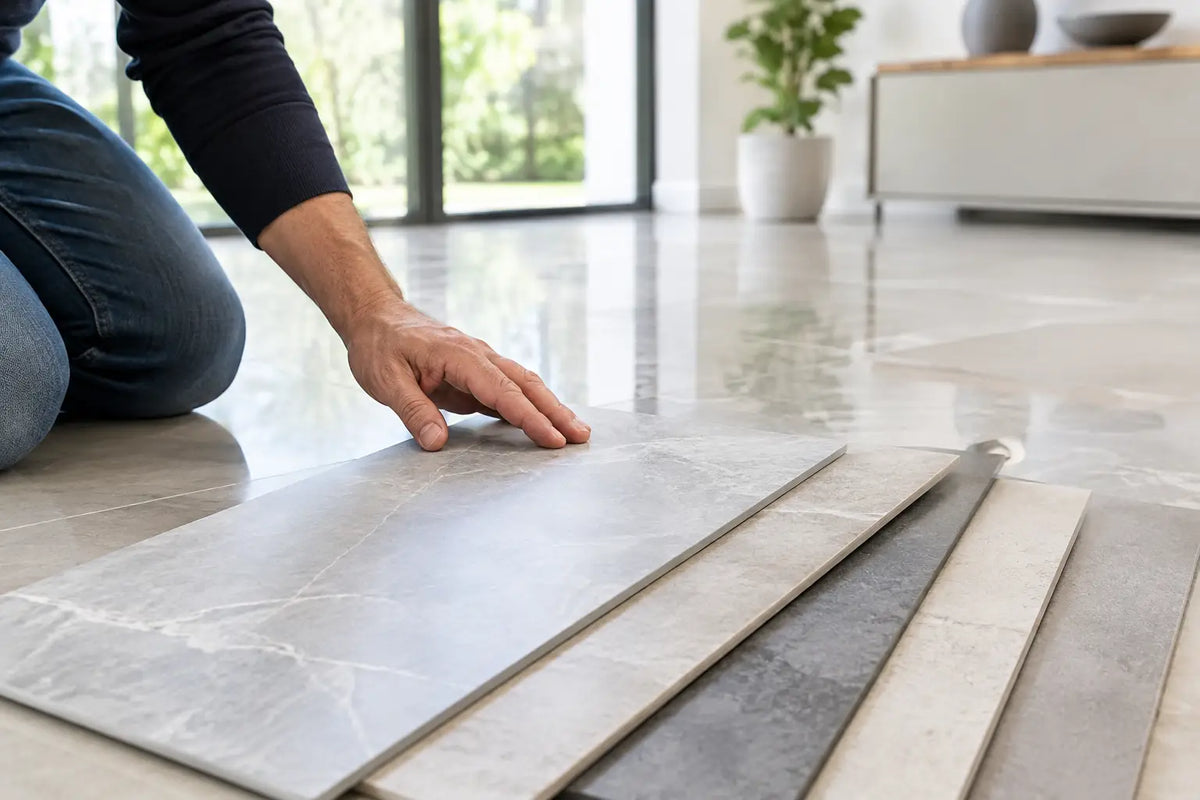
Then check the manufacturer's data for the relevant rating and test condition. A sample is invaluable for confirming colour, texture and finish in your own lighting, but it cannot replace technical performance information. It is also wise to view textured tiles in person, as a finish that feels perfect in a showroom may be more pronounced across a large open floor.
A well-specified porcelain floor should complement the room rather than compromise it. Choose a finish that supports the way the space is actually used, pair it with proper installation materials and maintenance planning, and you can retain the premium look of porcelain with greater everyday confidence.