Best Tiles for Wet Rooms That Perform Beautifully
A wet room asks more of a surface than a conventional bathroom. Water is directed across the floor, corners are constantly exposed to moisture and the finished look depends on accurate falls, drainage and detailing. The best tiles for wet rooms therefore need to do more than complement the scheme: they must suit the room’s use, provide appropriate grip and work with a properly waterproofed installation system.
For most projects, porcelain is the strongest all-round choice. It offers low water absorption, excellent day-to-day durability and an extensive choice of stone, concrete, terrazzo, marble and decorative effects. However, the right specification is never just about material. Tile format, surface finish, grout joints and the condition of the substrate all influence how the completed wet room performs.
What makes the best tiles for wet rooms?
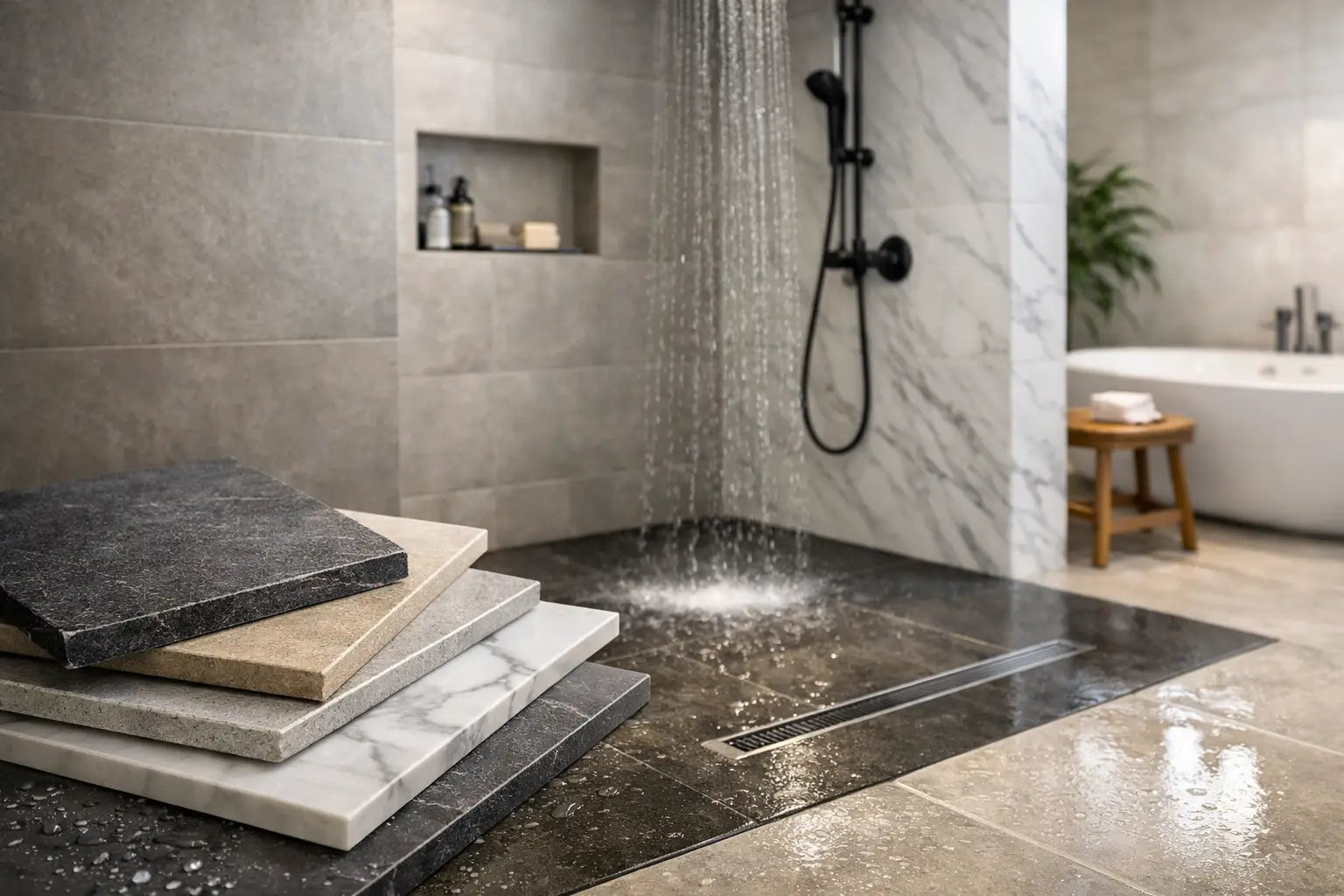
A well-specified wet room tile balances water resistance, slip performance, cleaning requirements and visual continuity. Tiles themselves are not the waterproof layer. Even a low-porosity porcelain tile has joints, perimeter edges and service penetrations around it. The floor and lower wall areas must be protected with a compatible tanking system or waterproof backer board before tiling begins.
For a domestic en-suite, the priority may be a calm, spa-like finish with a practical shower area. In a hotel bathroom, changing room or accessible washroom, more frequent use and higher safety requirements may lead to a different finish and smaller floor format. There is no single tile that is right for every wet room, but there are clear choices that reduce risk.
Porcelain for floors and walls
Porcelain tiles are generally the preferred option for wet room floors. Their dense construction makes them highly resistant to water absorption, staining and wear, while modern digital printing creates convincing natural-material finishes without the maintenance demands of many natural stones.
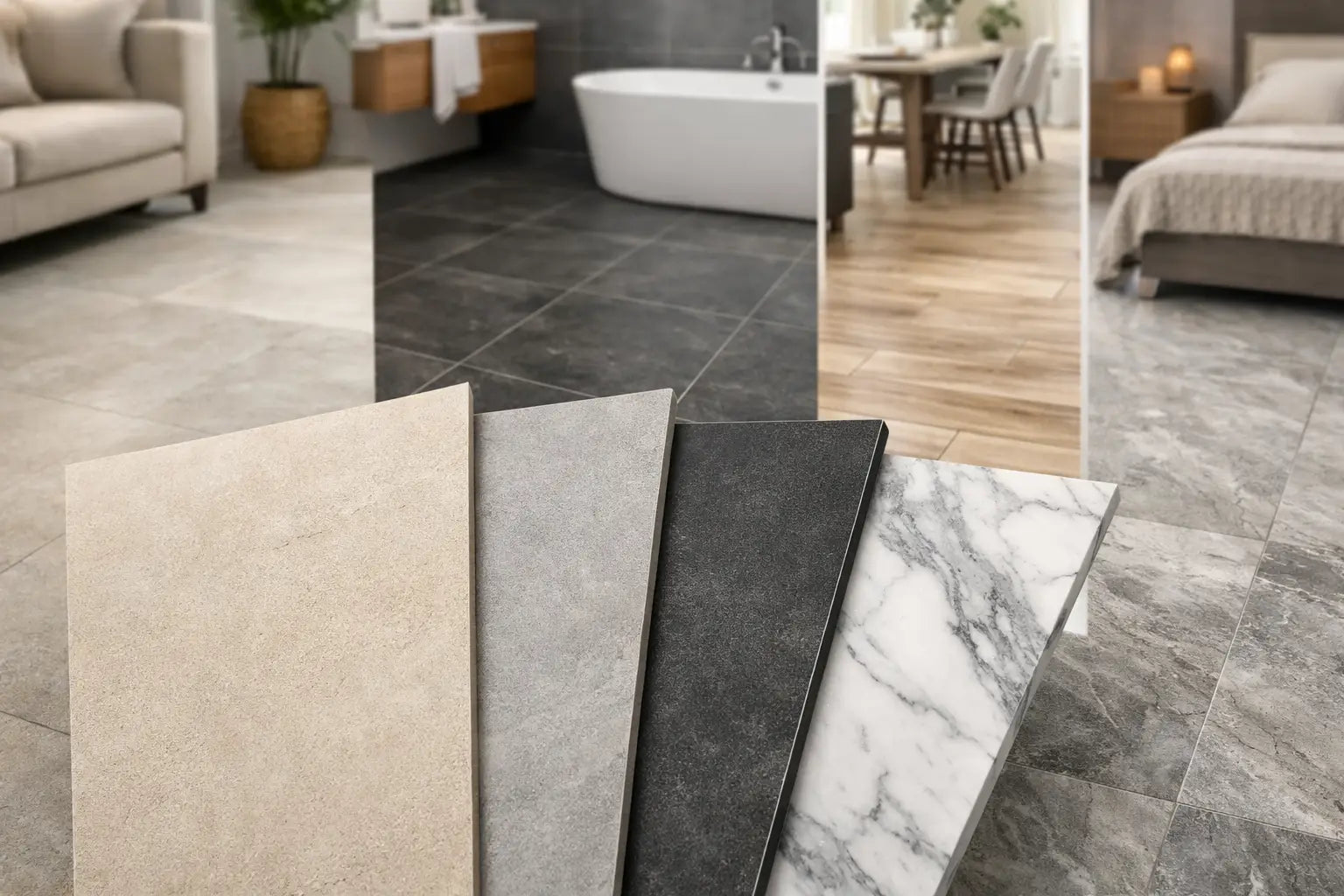
Stone-effect porcelain is particularly effective where a project calls for a warm, architectural surface that can run from shower floor to walls. Concrete-effect finishes suit contemporary schemes, while marble-effect porcelain gives a more formal, high-end result without relying on a porous polished stone. For busy family bathrooms and commercial washrooms, porcelain also stands up well to regular cleaning.
Select a matt, structured or suitably textured finish for areas that will be walked on wet. Highly polished porcelain can look striking on walls but is rarely the practical choice underfoot in a shower zone.
Mosaic tiles for shower floors and falls
Mosaics remain one of the most useful wet room floor solutions, particularly within the shower area. Because the individual pieces are small, they follow the slope towards a central or linear drain more easily than a large-format tile. The additional grout lines also provide more underfoot grip.
Porcelain mosaics are a dependable choice, available in hexagons, squares, penny rounds and kit kat styles. They can create a defined shower area while allowing larger tiles elsewhere in the room. This combination is often one of the most effective ways to retain a clean, design-led appearance without compromising drainage falls.
Mosaics do demand careful installation. Sheet-mounted products should be checked for consistent spacing, and grout must be selected to suit both the joint width and expected cleaning regime. A darker grout can be practical on a busy shower floor, while a carefully matched grout gives a quieter, more continuous effect.
Ceramic tiles for wet room walls
Ceramic wall tiles can be an excellent choice outside the direct floor area. They are available in a wide range of colours, gloss levels, handmade-inspired finishes and decorative formats, often at a more accessible price point than porcelain. Gloss ceramic tiles are especially useful on walls where they reflect light in compact bathrooms.
For full-height shower walls, porcelain provides extra reassurance and can coordinate with the floor, but ceramic is still suitable where it is installed over an appropriate waterproofed background. The key is to use the correct adhesive, grout and movement detailing rather than assuming a wall tile alone manages moisture.
Slip resistance: look beyond a matt finish
A tile described as matt is not automatically suitable for a wet room floor. Surface texture, tile profile and test data all matter. Ask for the manufacturer’s declared slip-resistance information for the exact tile and finish being considered. Depending on the product and project, this may include a pendulum test value, an R rating or another recognised classification.
Higher grip is not always better. Very heavily structured tiles can trap soap residue and take longer to clean, which may not suit a luxury en-suite. Conversely, a very smooth tile can become uncomfortable or unsafe when wet. The most appropriate finish depends on who will use the room, whether it is a level-access shower, how often it will be cleaned and whether the surface will be used barefoot.
For a family bathroom, a lightly textured porcelain with credible wet-slip performance is often a sensible starting point. For commercial or hospitality spaces, confirm the project’s specific safety and maintenance requirements before finalising the specification.
Tile size and layout matter more than expected
Large-format porcelain can make a wet room feel expansive, with fewer visible joints and a refined, contemporary look. It is particularly successful on walls and on the main floor area where the fall is gentle and consistent. A 600 x 600mm or 600 x 1200mm tile can create an impressive backdrop in a generous room, especially when paired with a linear drain.
The trade-off is installation complexity. Large tiles do not naturally bend to a four-way fall towards a central drain. They may need precise cuts, carefully planned layout lines or a separate mosaic shower tray area. Trying to force oversized tiles into an unsuitable slope can produce lipping, poor drainage and awkward cuts around the waste.
Smaller formats are more forgiving around falls and irregular room shapes. They bring more joints, which can be useful for grip, but they also introduce more grout to maintain. A successful layout considers the drainage position before tiles are ordered, not after the substrate has been prepared.
Rectified tiles allow narrower, more regular joints, but they should not be fitted edge to edge. Grout joints are necessary to accommodate manufacturing tolerances and movement, and appropriate perimeter movement joints remain essential in a wet environment.
Natural stone: beautiful, but specify carefully
Natural stone can give a wet room genuine depth and character, particularly with honed limestone, slate or marble. Yet it requires a more considered approach than porcelain. Many stones are porous to varying degrees and need sealing, while some can be affected by cleaning products, hard water marks or repeated exposure to soaps and shampoos.
A polished marble floor may be too slippery for a shower space, even if it suits the wall finish. Textured slate can offer useful grip but may require more detailed cleaning. If a natural-stone look is the priority but lower maintenance is preferred, a quality stone-effect porcelain will often offer a more practical long-term solution.
Where natural stone is selected, confirm its suitability for wet use, use compatible preparation and fixing products, and allow for its ongoing sealing and care requirements. This is particularly relevant for commercial schemes, where maintenance routines need to be realistic as well as aesthetically ambitious.
The installation system is part of the specification
Even the finest tile cannot compensate for poor preparation. A wet room floor needs a stable, correctly formed substrate with falls that direct water efficiently to the drain. Before tile installation, the substrate should be waterproofed with a suitable tanking system, including corners, junctions, pipe penetrations and the drain connection.
Use a flexible adhesive designed for the tile type, background and environment. Large-format porcelain may require a higher-performance adhesive and appropriate trowel technique to achieve good coverage. On floors, solid bed fixing is normally required to avoid voids beneath the tile, which can lead to cracking or water pooling.
Grout is equally significant. A quality flexible cement-based grout is suitable for many residential wet rooms when maintained correctly. Epoxy grout offers very high stain and water resistance and can be valuable in demanding shower areas or commercial settings, but it is more specialist to apply and may increase installation costs. Silicone sealant, rather than grout, should be used at changes of plane and movement joints.
Choosing with confidence
Start by deciding how the wet room will be used, then choose the finish. A softly textured porcelain may be ideal for the main floor and walls; matching porcelain mosaics can manage the shower fall; a glazed ceramic or decorative porcelain feature can add character above the basin. Ordering samples is worthwhile, as a finish that looks subtle on screen can feel markedly smoother, darker or more textured in person.
Check the tile’s intended application, slip data, suitability for underfloor heating where relevant and recommended installation materials before placing the order. Allow for cuts, layout and sensible wastage, particularly with directional veining, patterned tiles and large formats. Smart Tiles can help bring the tile, grout, trims, adhesive and waterproofing elements together so the specification is ready for installation rather than just visually appealing.
The most successful wet rooms feel effortless once complete, but that result comes from making practical decisions early. Choose a surface you will enjoy seeing every day, then give equal attention to grip, drainage, waterproofing and the installer’s laying plan. That is how a premium finish stays convincing long after the project is handed over.