Are Porcelain Tiles Too Heavy for Walls?
If you are asking are porcelain tiles too heavy for walls, the short answer is no - not when the wall is sound, the tile is specified correctly, and the right fixing materials are used. Weight matters, but it is only one part of the decision. In most interior projects, failure comes from the background, adhesive choice, or poor preparation rather than the porcelain itself.
That is why porcelain wall tiling needs to be judged as a system rather than a product in isolation. The tile, the substrate, the adhesive, the primer, and the room conditions all need to work together.
Are porcelain tiles too heavy for walls in normal rooms?
In bathrooms, kitchens, utility rooms and feature walls, porcelain tiles are commonly used on walls without issue. Modern adhesives and tile backer systems are designed to support them, and many porcelain ranges are suitable for both wall and floor use. For homeowners, that often means a cleaner design scheme with the same tile running across surfaces. For installers and specifiers, it can simplify product selection and keep the finish consistent.
The point where concern becomes justified is when large-format porcelain is being fixed to a weak or unsuitable background. A compact 300 x 600 mm porcelain wall tile places very different demands on a wall than a 1200 x 600 mm panel. Thickness also matters. A slim porcelain tile can be perfectly practical on a wall, while a thick heavy-duty floor tile may be less appropriate overhead or on a poor substrate.
So the right question is not simply whether porcelain is too heavy. It is whether that specific porcelain tile is suitable for that specific wall.
What makes a wall suitable for porcelain tiles?
A suitable wall needs to be stable, flat, dry where required, and capable of carrying the tiled finish long term. Plasterboard, tile backer boards, cement boards, solid plaster, blockwork and properly prepared masonry can all be suitable in the right setting. The key is to check both the condition of the surface and the tile weight limits recommended for the substrate.
Standard plasterboard in dry internal areas may accept tiles up to a certain weight per square metre, but wet areas and heavier porcelain usually call for a more robust approach. In showers and high-moisture bathroom zones, tile backer boards are often the safer option because they offer improved stability and moisture resistance. On refurbishment projects, this matters even more, as existing walls are not always as solid as they look.
Flatness should not be overlooked. Large porcelain wall tiles need a flatter background than smaller formats. If the wall is uneven, the installer can end up using too much adhesive to compensate, which is not good practice and can affect bond strength.
Weight is not the only issue
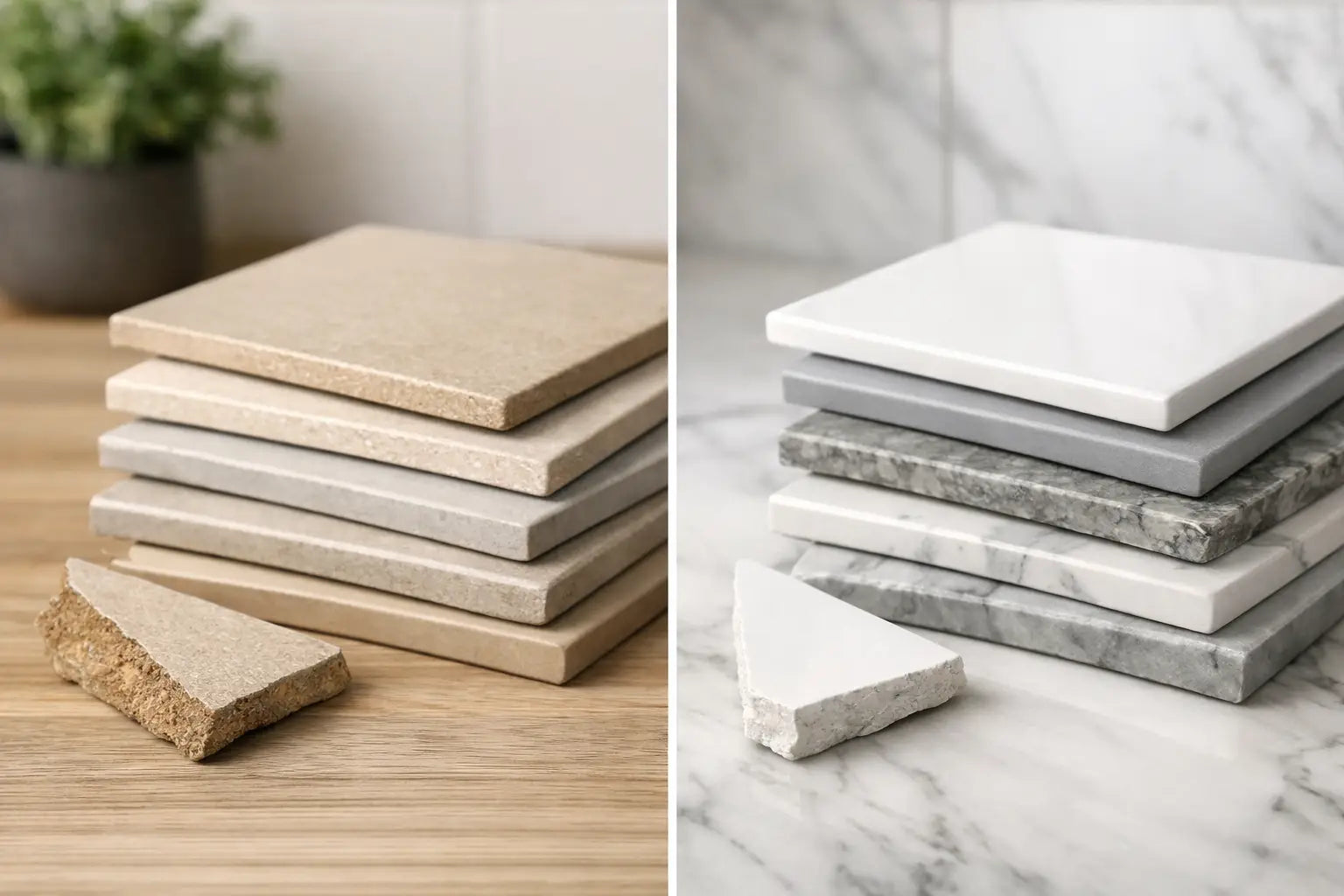
People often focus on kilograms per tile, but tile performance on walls is affected by more than mass alone. Tile size, porosity, back profile and room use all influence the installation method. Porcelain is denser and less porous than ceramic, which is one reason it performs so well in demanding interiors. It also means the adhesive needs to be suitable for porcelain rather than treated as a generic wall tile job.
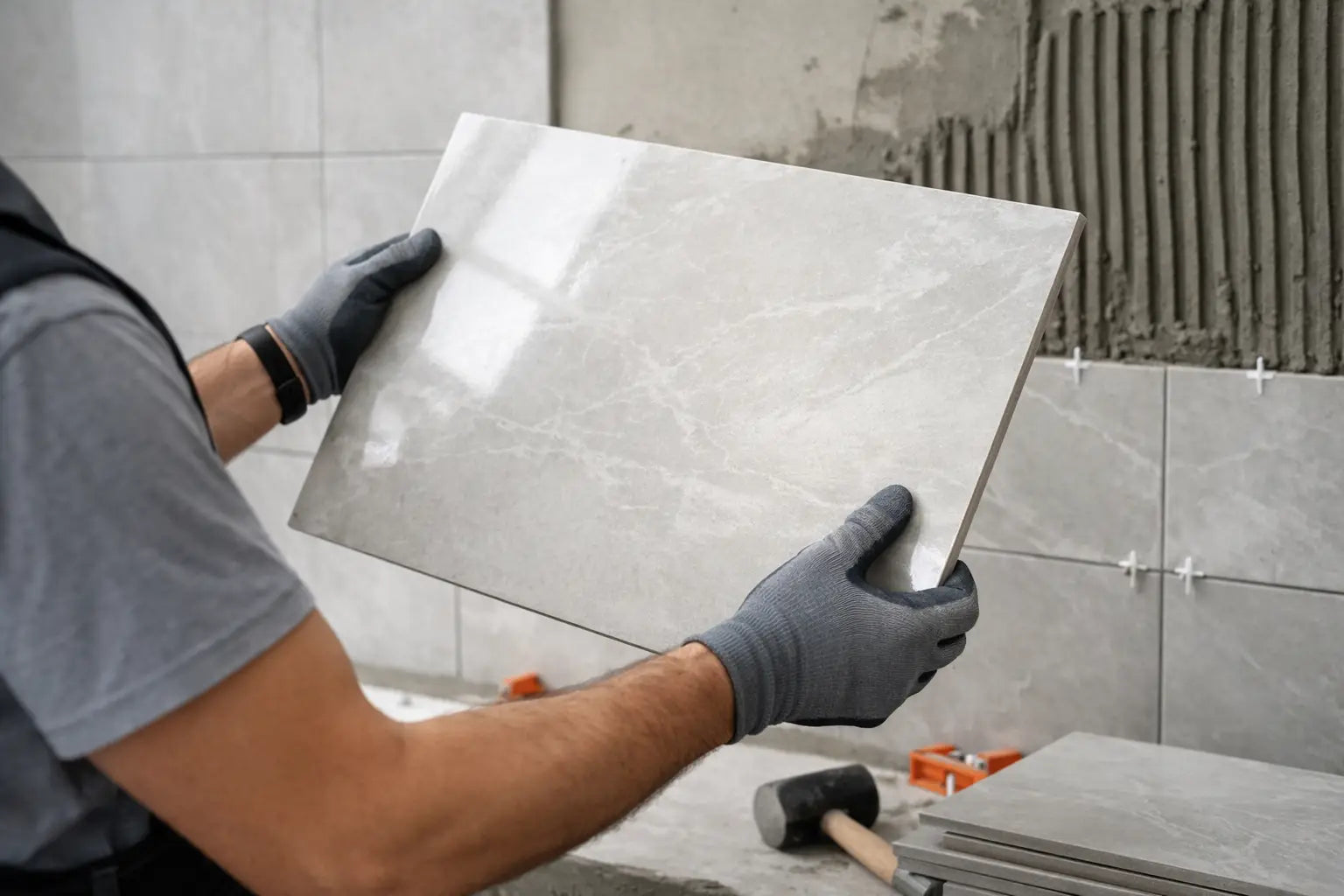
Larger tiles create more leverage on the wall because of their dimensions. A tile does not need to be exceptionally heavy to become awkward if it is large, especially in vertical applications. That is why installers often use deformable adhesives, levelling systems and careful handling methods for bigger formats.
There is also a practical site question. A wall may technically support a tile, but if the format is difficult to manoeuvre in a tight en-suite or above a worktop, the risk of poor fixing increases. Good specification is not just about what is possible. It is about what can be installed reliably.
Are porcelain tiles too heavy for bathroom walls?
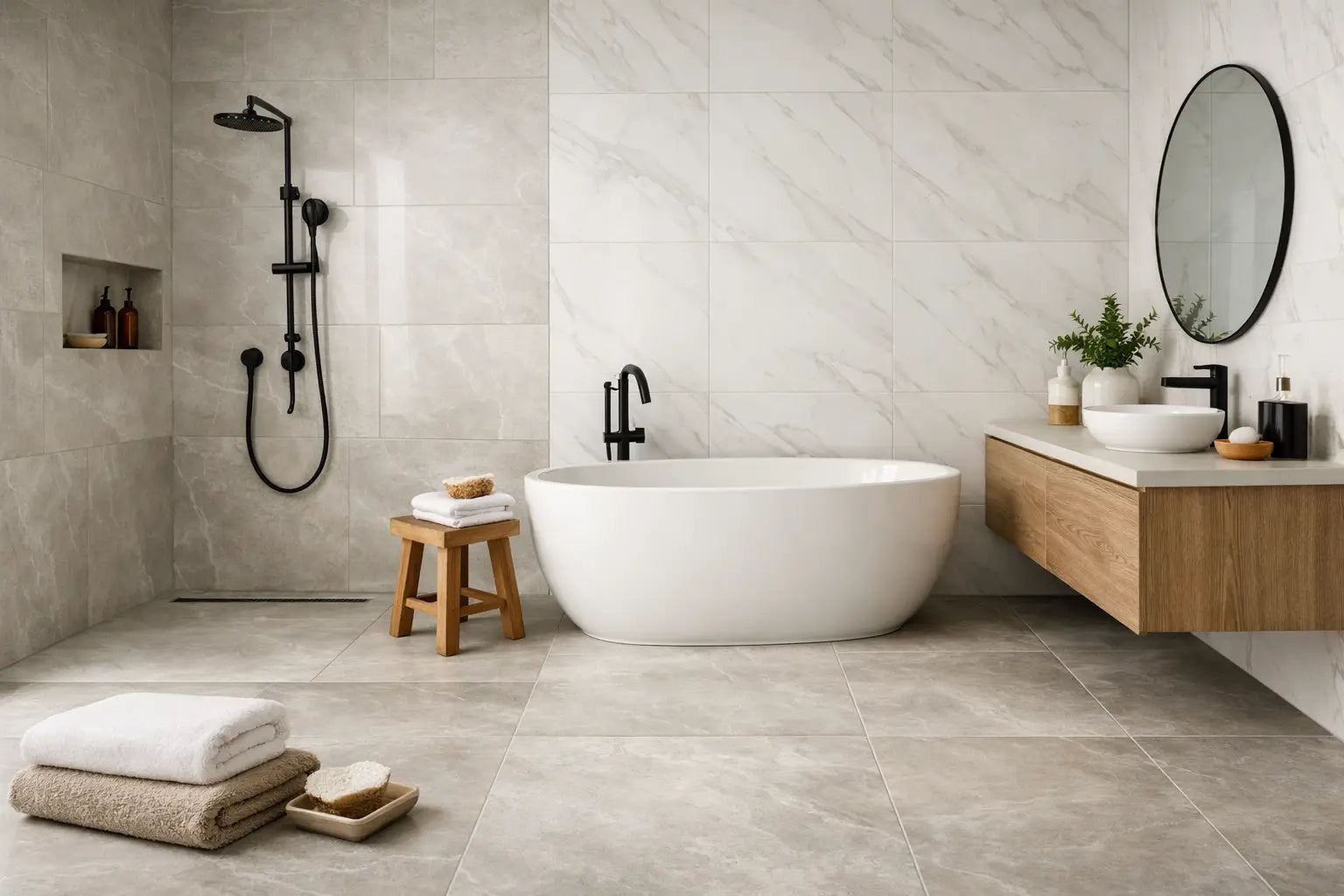
Bathroom walls are one of the most common places for porcelain. They offer excellent water resistance, a clean finish and strong stain resistance, which makes them particularly suitable for shower enclosures, wet room walls and splash zones. In many cases, porcelain is a better long-term choice than standard ceramic, especially where durability and low maintenance matter.
The important distinction is between a bathroom wall that has been built or prepared for tiling and one that has not. Freshly installed tile backer board, correctly waterproofed where necessary, gives a much better base for porcelain than tired plaster, loose paint, or damaged boards. If the project involves a wet area, the wall should be tanked or waterproofed to the system requirements before tiling begins.
For heavier or larger-format porcelain in bathrooms, mechanical support during installation may also be needed while the adhesive cures. That is normal and should be planned for rather than treated as a problem.
Adhesive choice matters as much as tile weight
If a porcelain tile comes away from a wall, the adhesive specification is often where the investigation starts. Porcelain needs an adhesive suitable for its low water absorption. In many interior wall applications, that means a high-performance cement-based flexible adhesive, selected to suit the substrate, tile size and environment.
Ready-mixed adhesives are not always the right answer for porcelain, particularly with larger formats or in wet areas. Because porcelain is very low in porosity, the adhesive needs to cure properly and achieve the right bond. A powdered adhesive mixed on site is often the better technical choice for these installations.
Coverage is equally important. Large-format porcelain wall tiles generally need a solid bed of adhesive with good contact on the back of the tile. Voids can weaken the installation and create stress points. Back-buttering may be required depending on tile size and manufacturer guidance.
When porcelain may be the wrong wall tile choice
There are situations where porcelain is not the best option, but that does not mean it is inherently too heavy for walls. If the existing substrate is weak and cannot be upgraded easily, a lighter ceramic wall tile may be more practical. If the project involves very high walls, difficult access, or overhead installation details, the handling demands of large porcelain can increase labour and risk.
Budget can also influence the decision. Porcelain often delivers better durability and design flexibility, but the installation may be more demanding than a lighter wall tile. For some straightforward decorative walls, ceramic remains a sensible option.
This is where product selection should stay grounded in the actual room. A small cloakroom splashback, a hotel bathroom refurbishment and a full-height feature wall in a commercial reception do not all need the same tile.
How to judge if your wall can take porcelain
Start with the tile specification. Check the tile size, thickness and intended use. Then look at the wall build-up, including board type, fixings, moisture exposure and overall condition. After that, match the adhesive and preparation products to the tile and substrate rather than choosing them as an afterthought.
For homeowners, the safest route is to confirm the wall type before ordering large quantities. For trade buyers and specifiers, it is worth checking substrate load limits and installation guidance at the outset, especially on larger-format porcelain. A sample can help with design decisions, but technical suitability still needs to be confirmed against the build-up.
Where there is any doubt, upgrading the background usually makes more sense than compromising on the finish. Reboarding a wall with a suitable tile backer system is often a cleaner solution than trying to make a poor substrate carry a premium tile.
Common mistakes when fixing porcelain to walls
Most problems are predictable. Tiling onto painted or unstable surfaces, using the wrong adhesive, ignoring movement requirements, and trying to level severe wall irregularities with adhesive all increase the chance of failure. Another frequent mistake is choosing a tile based only on appearance without considering format and handling.
In domestic projects, a wall may look solid enough but still be unsuitable once old finishes are removed. In commercial settings, programme pressure can lead to backgrounds being tiled before they are fully ready. Neither saves time in the long run.
A dependable result comes from treating wall tiling as a build-up, not just a finish. That includes trims, grout, waterproofing where needed, and the correct boards and primers underneath. Smart Tiles supports that process by supplying both the surface products and the installation materials needed to complete the specification properly.
The practical answer
Porcelain tiles are not too heavy for walls by default. They are a strong, durable and design-led option for many internal wall applications, including bathrooms and kitchens. The deciding factors are tile format, wall condition, substrate type and adhesive system.
If the wall is properly prepared and the tile has been chosen with the installation in mind, porcelain is often an excellent wall finish. If the background is weak, damp-prone or uneven, the answer is not necessarily to abandon porcelain - it may be to improve the substrate first.
A good wall tile decision should leave you confident not just in how the tile looks on day one, but in how it performs after years of daily use. That is usually where the right preparation proves its value.