
Article: European Tile Review: What Quality Looks Like
European Tile Review: What Quality Looks Like
A European tile review should go beyond country of origin and a beautifully styled room image. For a bathroom, kitchen, hallway or commercial interior, the value of Italian and Spanish tile lies in the combination of considered design, reliable manufacturing and a range of formats and finishes that can be specified with confidence.
European collections are often where new surface trends first become commercially usable: quieter stone effects, convincing wood grains, tactile matt finishes, decorative reliefs and large-format porcelain that gives a room a more continuous appearance. That does not mean every European tile is automatically right for every project. The best choice depends on location, expected traffic, slip requirements, substrate condition, budget and the level of maintenance a client is prepared to accept.
What defines a quality European tile?
Italy and Spain remain leading centres for tile design and manufacture, particularly in porcelain. Their strongest collections are developed not simply as individual products but as coordinated surface ranges. A stone-effect floor tile may be available in several sizes, with matching wall formats, mosaics, trims or outdoor options. This gives homeowners and specifiers greater control over the finished scheme.
The quality is often most evident in the details. Printed faces vary more naturally across a batch, so a marble or stone effect does not repeat too obviously. Edges may be precisely rectified, allowing narrower grout joints where the installation and tile calibration permit. Surface finishes are designed to achieve a particular balance: a polished tile can bring light and refinement, while a matt or structured finish may be more appropriate where grip and lower visual maintenance are priorities.
For high-end residential work, this design depth matters. A tile is a fixed architectural finish, not an accessory that can be changed with little disruption. Choosing a well-developed collection helps a room feel intentional from floor to wall, shower area to splashback, or reception space to circulation route.
European tile review: porcelain versus ceramic
Porcelain is the principal choice for demanding floor applications. It is dense, low-absorption and highly durable, making it suitable for kitchens, hallways, bathrooms and many commercial settings when the selected product is rated for the application. Modern porcelain can reproduce limestone, travertine, terrazzo, concrete, timber and marble with impressive accuracy, while avoiding some of the sealing and staining concerns associated with natural materials.
Its strength is not a reason to overlook preparation. Large porcelain tiles need a suitably flat, stable base, an appropriate flexible adhesive and sound fixing practice. A poor substrate can compromise even an excellent tile. For floors with underfloor heating, movement accommodation, adhesive selection and gradual commissioning of the heating system should all form part of the plan.
Ceramic wall tiles offer a different kind of value. They are usually lighter and easier to cut than porcelain, and they provide a broad choice of colour, glaze, shape and decorative detail. Glazed ceramic is particularly effective for kitchen splashbacks, bathroom walls and feature areas where colour or reflected light is central to the design. A handmade-look ceramic tile can introduce variation and warmth that would be harder to achieve with a large, uniform porcelain panel.
The distinction is practical rather than hierarchical. Porcelain is generally the more versatile technical material, especially for floors. Ceramic can be the more appropriate visual choice for a wall-led scheme. Always check the intended use of the individual product rather than assuming that a tile is suitable because it looks substantial or belongs to a particular collection.
Finish, format and colour change the result
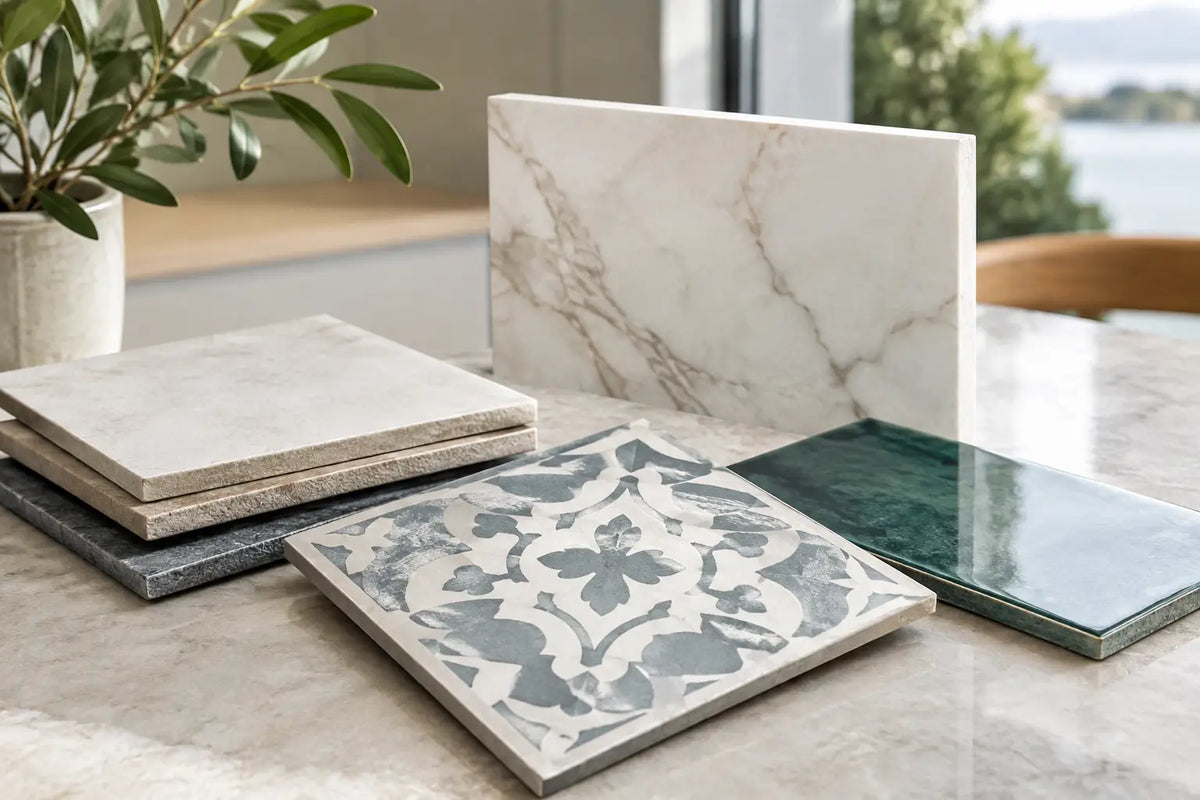
A tile sample is essential because a screen cannot fully show texture, sheen or tonal movement. Matt finishes are popular for their understated appearance and their ability to soften daylight and artificial lighting. They can also be more forgiving of water marks and fingerprints than polished finishes. In a shower or entrance area, however, the required slip performance must be considered separately from appearance.
Polished porcelain has a crisp, luxurious character that suits lower-traffic living spaces, walls and carefully designed bathrooms. It can make a smaller room feel brighter, but its reflective surface will show dust, splashes and smears more readily. It may not be the best fit for a busy family kitchen or a lobby subject to wet footwear.
Format has an equally strong effect. Large tiles reduce the number of grout joints and can make open-plan spaces feel calmer. They demand accurate setting out, careful handling and a flat substrate, so labour and preparation costs may be higher. Smaller formats, mosaics and patterned tiles offer more flexibility around falls, niches and awkward dimensions, and they can create a focal point without overwhelming a room.
Pay attention to shade variation, often indicated as V1 to V4. A low-variation tile gives a more consistent, controlled look. Higher variation is useful where the aim is to recreate the irregularity of natural stone or timber. It is wise to view several pieces together, particularly with marble-effect and stone-effect porcelain, before confirming the full quantity.
What to check before specifying European tiles
Beautiful tiles still need to work with the practical conditions of the project. Before ordering, confirm the usable dimensions of the space, including recesses, doorways, steps and planned furniture. Decide whether full tiles should be prioritised at the main entrance, on a feature wall or around a central fitting. Early setting-out decisions can prevent narrow, awkward cuts becoming the first thing seen in a finished room.
For floors, establish the substrate type and condition. Timber floors, screeds, existing finishes and newly laid substrates require different preparation methods. Floor levelling compounds, tile backer boards, uncoupling systems and flexible adhesives are not optional extras when the installation calls for them. They are part of achieving a durable result.
For wet areas, consider the whole system rather than the tile alone. Waterproofing beneath the finish, suitable drainage falls, compatible adhesive and grout, and correctly sealed changes of plane all contribute to performance. A tile itself may be water-resistant, but grout joints and the substrate behind them still need proper protection.
Commercial buyers should also assess loading, cleaning regimes, slip resistance and continuity of supply. A hotel bathroom, retail floor or restaurant entrance will have different needs from a private en suite. In public-facing areas, selecting a finish only on appearance can create avoidable maintenance or safety issues later.
Quantity, grout and finishing materials matter
Ordering the exact measured coverage is rarely enough. Allowance is needed for cuts, breakages, pattern matching and future repairs. The right percentage varies with tile size, room shape and laying pattern. A simple square room may need a modest allowance; a diagonal layout, herringbone pattern or room with numerous returns will require more. Ordering a sensible quantity from the same batch at the outset is usually preferable to trying to match a tile later.
Grout deserves the same consideration as the tile. A close colour creates a quieter, more continuous finish, while a contrasting grout makes the grid and tile shape more prominent. Larger-format rectified porcelain often suits a narrow joint, but joint width must accommodate the tile, setting-out and fixing conditions. A skilled installer will not force an impractically tight joint simply to imitate a showroom image.
Trims, movement joints and sealants should be selected early as well. Metal trims can introduce a fine architectural edge around niches and external corners, while colour-matched trim or silicone may be preferable for a softer finish. These small decisions have a visible impact on the perceived quality of the completed installation.
Are European tiles worth the investment?
For many projects, yes, because the investment is in more than the tile face. Better European ranges tend to offer stronger design consistency, more considered sizes and accessories, dependable technical information and finishes suited to contemporary interiors. This can reduce compromise during specification and help create a result that still feels current years after installation.
However, the most expensive option is not automatically the best value. A premium large-format porcelain may be unnecessary in a compact utility room where a well-chosen smaller tile is easier to fit and less wasteful. Conversely, choosing a lower-cost tile for a high-traffic entrance may prove false economy if it lacks the required durability or if replacement stock becomes difficult to obtain.
At Smart Tiles, samples, coverage planning and compatible installation materials help turn a preferred European surface into a practical project specification. Start with the room's demands, then compare finishes in the actual light of the space. The right tile is the one that earns its place every day: visually assured, appropriately specified and installed with the care its design deserves.

